
NOTES — RESEARCH NOTES
Names & Cross Formulas
In the Dyckia world, the cross formula written on a label or in a post is itself the body of the information. Knowing how names are formed, the order of a formula, the generation marks, and the abbreviations in use lets you read the records accurately. The cultivar pages on this site are written by the conventions set out here.
Writing NamesNAMES
Species names are written in italics, as in Dyckia marnier-lapostollei; cultivar names in single quotes, as in Dyckia ‘Brittle Star’. This is the international standard.
What matters is that a cultivar name belongs not to a grex of seedlings but to one selected individual (a clone) chosen from among them. Plants carrying that name are, in principle, vegetative propagations — offsets — of that individual. Not every seedling from the same cross may bear the parent cultivar's name. Giving seedlings the parent name unchanged is a classic error, and one that damages trust in records.
Reading a Cross FormulaCROSS FORMULAS
A formula is written "seed parent × pollen parent": the left side bears the seed (the mother), the right side provides the pollen (the father). This order is an international horticultural convention, not limited to bromeliads. In complex crosses, parentheses show the structure of the generations.
Example: (‘Warren’ × ‘Heaven and Hell’) × ‘Nagas’ — first ‘Warren’ was crossed with ‘Heaven and Hell’, and a seedling of that cross was then crossed with ‘Nagas’. Japanese listings use the same format, adding individual numbers and the breeder's or hub's name to the formula.
The mark var. after a species name denotes a variety (varietas), as in Dyckia marnier-lapostollei var. estevesii. sp. marks a plant not identified to species; aff. marks an unidentified plant close to the named species.
Generations — F1, F2, F3GENERATIONS
F1 is the first seedling generation from a cross. Crossing F1 plants with each other (or selfing an F1) gives F2, then F3, and so on. Because traits segregate in F2, the selection of superior individuals is done mainly from F2 onward.
A generation mark after a cultivar name, as in ‘Brittle Star’ F3, says which seedling generation of that cultivar — or of the line leading to it — the plant belongs to. Seedling generations and the named, selected clone are recorded as different things.
AbbreviationsABBREVIATIONS
Long names are often shortened inside formulas. This archive uses the following five abbreviations.
| ML | Dyckia marnier-lapostollei. The same expansion is used in the published material of the Thai breeder Q Dyckia. |
|---|---|
| BS | ‘Brittle Star’ — a registered cultivar by Bill Baker (BCR #2335). |
| DM | ‘Donna Marie’ (a registered cultivar by Bill Baker and Bryan Chan, BCR #13549). This abbreviation is used in our own records; it is not a general convention. |
| HH | ‘Heaven and Hell’. Q Dyckia's material states "HH = Heaven and Hell" explicitly. |
| 4OJS | ‘4th of July Series’ (written 4JOS outside Japan) — a cross-series code of Bill Baker's; individuals are distinguished by numbers such as XXX1-2. The code also appears as-is in BCR records: in ‘Nagas’ (BCR #14330), by Sueb Anyamaneetrakul of Thailand, the seed parent is recorded as “4JOS#202” (the pollen parent is ‘Bone’, a selected clone of the ‘Brittle Star’ F3 grex). The series is sometimes attributed to the Japanese breeder Kenji Matsuda, but that is a misreading: the code “4OJS XX1-3” appears as a pollen-parent code in the pedigree of Matsuda's own registered cultivar ‘Patriot Crown’ — the series itself is not Matsuda's. |
These are private shorthand used among hobbyists, not formal cultivar names. The BCR's registration rules also treat abbreviations in cultivar names as undesirable (see BSI & Cultivar Registration). On this site's cultivar pages, formulas are written out in full as a rule, and the abbreviations are explained only here.
Codes & Selection NumbersCODES & SELECTION NUMBERS
Before a plant receives a name, it is often managed under a code assigned by its breeder or nursery. Each system of codes means something different, and the same number can occur in more than one system, so a number alone cannot establish a plant's origin. Some numbers remain unexplained: a number such as LS061, attached to an F2 seedling of ‘Jaws’, has been seen in domestic circulation.
The D Numbers of Michael Kiehl
These are selection numbers of Michael's Bromeliads, a Florida nursery, in the form "D + number". They were assigned both to seedlings of ‘Brittle Star’ F3 and to a group raised by selfing ‘Mercury’. The latter group is called the Battle series; among the numbered plants that received names are D029 ‘Battle Axe’, D024 ‘Battle Cry’ (named by a member of the nursery's staff), and D028 ‘Hatchet’ (a proposed name that was adopted). D013 is called ‘Great white’, D016 ‘Rolling Stone’, and D054 ‘White Trooper’. Other numbers circulate without names: D019 is an unnamed clone of the ‘Mercury’ F2 group, and D027 is recorded as a plant of the Battle series. D numbers have also entered breeding in Japan, where D007 is recorded as the pollen parent of a domestic cross (seed parent ‘Donna Marie’).
One caution: the number D033 appears both in Q Dyckia's system of ‘Brittle Star’ F3 selections and in Kiehl's system. Whether the two form a single system is not known; D033 has been used in Japan as a parent in a cross formula, but a matching number alone does not make the origins the same.
D-numbers also appear in the seedling groups of Sueb of Thailand. His ‘Brittle Star’ F3 selection ‘BS #11’ and the ‘D11’ in the seed-parent formula of the BCR-registered ‘Phoenix’ refer to the same clone. It is another case of the same number form arising under a different breeder, where origin has to be judged from context, not from the number alone.
The Baker Tracking Codes
These three-letter tracking codes were used by Bryan Chan, who took over the management of Bill Baker's cross groups. In domestic records, a plant carrying the code BBB is grown in Japan and was used in 2024 as a parent in a cross with braunii. One record gives BBB's formula explicitly as ‘Brittle Star’ × ‘Arizona Small’. Many other coded plants — ABB, ACC, CAA and more — are also in circulation in Japan. The spelling FBB has also been sighted in Japan, but whether it belongs to the same system has not been confirmed. Codes whose names are known include FLL = ‘Donna Marie’, FAA = ‘Big Brother’, FOO = ‘Uncle Ray’, and FSS = ‘Aunti Vi’. For ‘First Cousin’ and ‘Second Cousin’, the sources disagree on which code belongs to which name, and the matter cannot be settled from the records.
The EL Collection Numbers
Numbers beginning with EL are understood to be collection numbers of the Brazilian botanist Elton Leme. Known examples are #EL2508 of goehringii and EL-2959 of jonesiana. EL-2959 appears in more than one domestic record, which lets us follow a number travelling together with its plant. EL4146 appears together with the number SEL07-0348 on plants recorded as cf. choristaminea, in more than one domestic record.
Decoding a Formula — Worked ExamplesDECODING — WORKED EXAMPLES
The cultivar pages on this site carry a “Reading the Formula” block that sets out a formula parent by parent. Two worked examples show how it is read. Our own crosses are recorded with the cultivar name followed by “Crossed:” and the year the cross was made, and by Seed Parent / Pollen Parent lines — a wording that makes clear the year is the year of the cross, not of the seed itself.
Example 1 — a cross preserved as codes in the BCR record (‘Nagas’, BCR #14330).
-
STEP 1 — THE CROSS
‘4th of July Series’ #202 × ‘Bone’
→ In the register, the seed parent is recorded under the code “4JOS#202” and the pollen parent as ‘Bone’. The plant that came from this cross is ‘Nagas’, bred by Sueb Anyamaneetrakul and registered in Thailand in 2013.
About the parents
- 4JOS#202 — the code for individual #202 of Bill Baker's cross series ‘4th of July Series’. The series name is written 4OJS in our own records and 4JOS outside Japan.
- ‘Bone’ — a clone selected from the ‘Brittle Star’ (BCR #2335) F3 seedling grex, recorded as the pollen parent in the BCR entry for ‘Nagas’. ‘Bone’ itself is not registered.
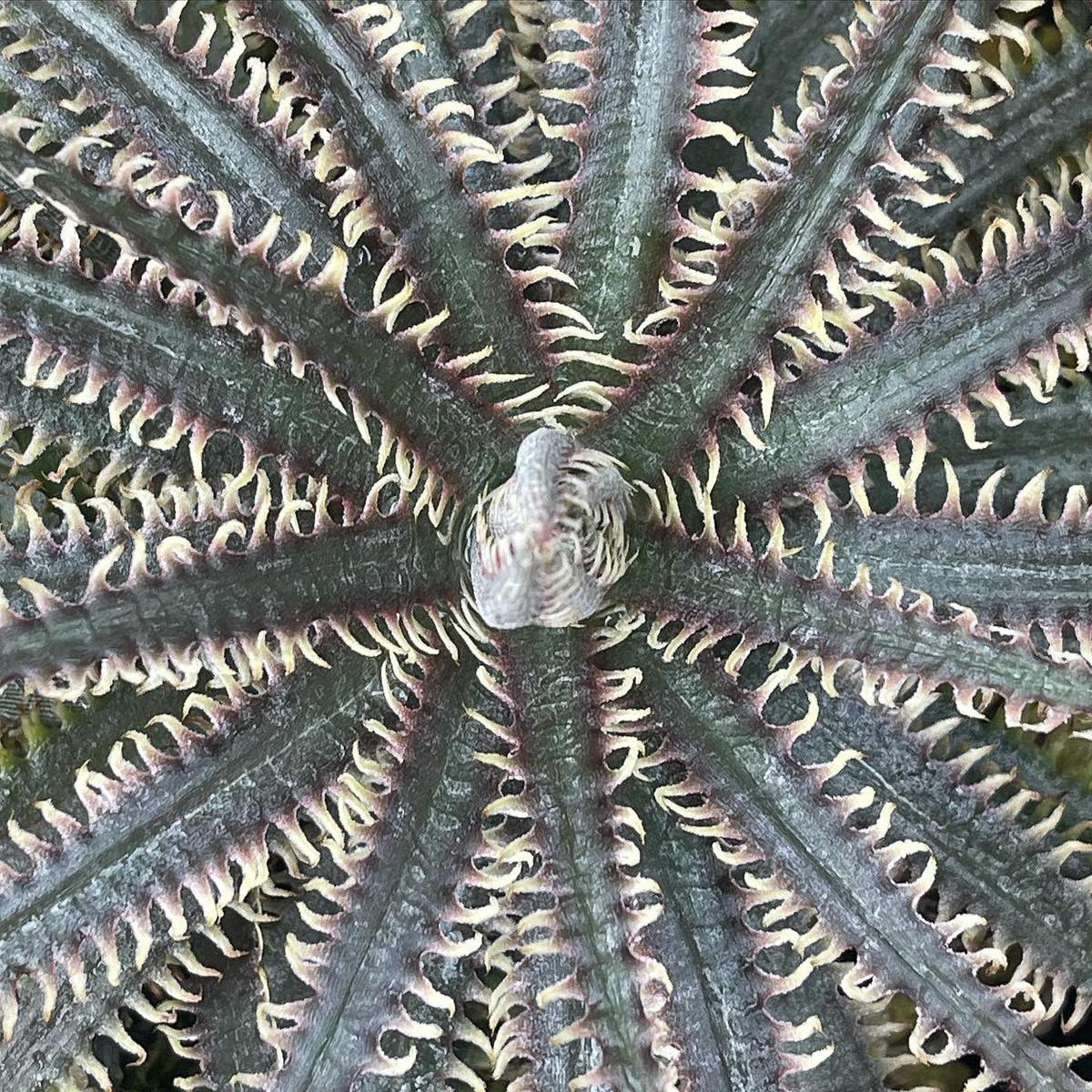
Example 2 — one of our own crosses (‘Engawa’).
-
STEP 1 — THE CROSS (Crossed: 2022)
‘Jaws’ × marnier-lapostollei
→ The seedling grex raised from the 2022 cross (record tag #tgn_hyb_jm_01).
-
STEP 2 — SELECTION
seedling grex → selected individual
→ The individual we selected from the grex and named is ‘Engawa’ — an instance of the rule that a name belongs to one selected clone.
About the parents
- ‘Jaws’ — a BCR-registered cultivar (#14722), registered in 2018 with Makoto Saito handling the Reg. Doc.; but its origin, breeder and parentage are not in the BCR record.
- marnier-lapostollei — the species Dyckia marnier-lapostollei, written ML in our own formulas.
Record TagsRECORD TAGS
On this site and on Instagram, each plant carries a record tag that ties posts to its cultivar page. #tgn_dyc_… covers species and cultivars; #tgn_hyb_… covers crosses and seedlings.
Overseas breeders' individual numbers are also kept in the records exactly as written. Examples: the D-numbers that mark individual clones of ‘Brittle Star’ F3 (such as ‘D011’), Q Dyckia's clone line HU-5, and the selected clone name ‘Bone’ (a selection of ‘Brittle Star’ F3). Some sellers' tags, on the other hand, have no publicly documented meaning; those are transcribed as-is, never expanded by guesswork.
Researched: October 2026