
NOTES — RESEARCH NOTES
Species Profile — Dyckia monticola
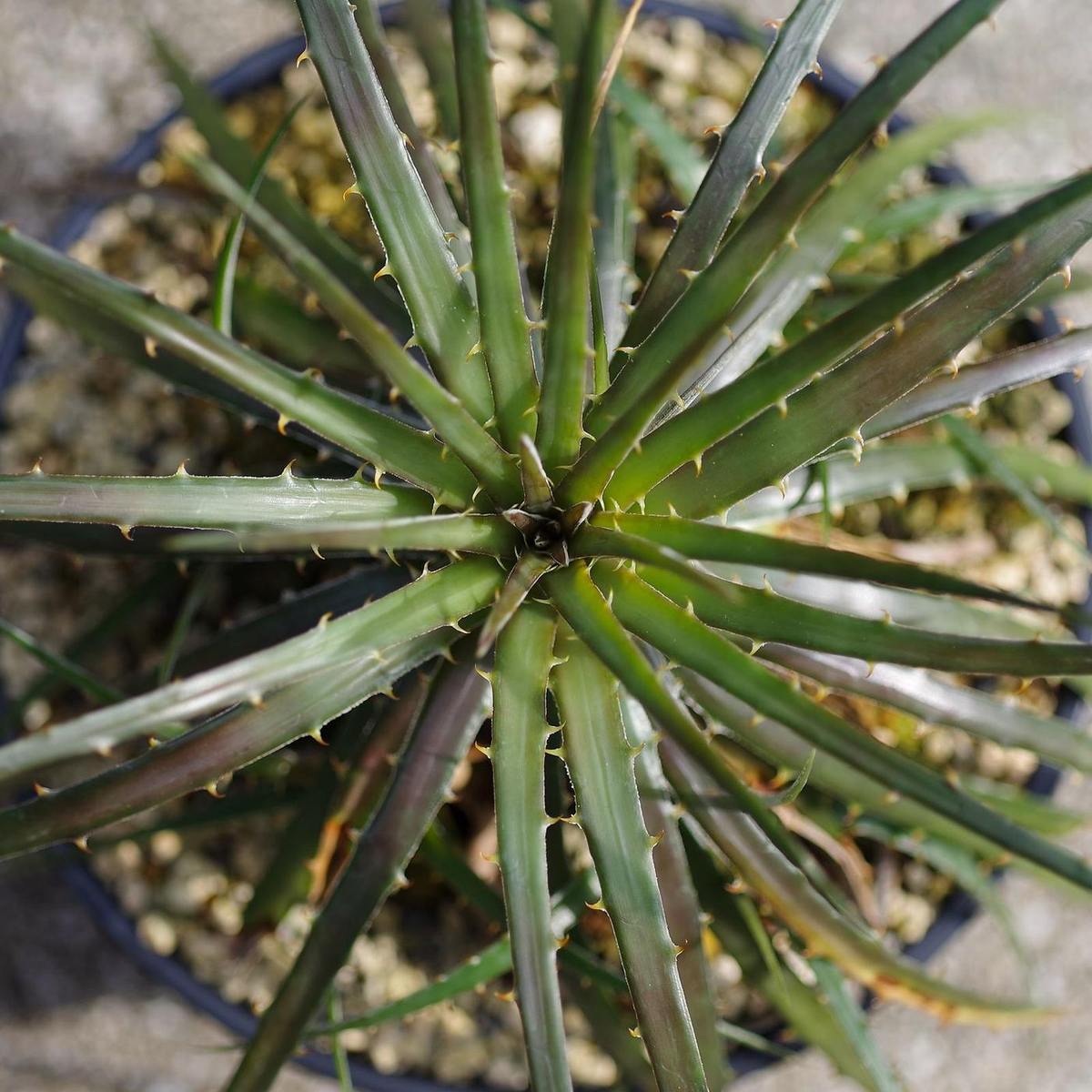
The first of our Species Profiles is Dyckia monticola — the plant this archive has called its “eternal favourite” since the earliest records. The key point first: monticola is not a hybrid. It is a species, described under a scientific name in 1962 from wild Brazilian material — a different origin from a cultivar raised by crossing. This note checks the description, the habitat and the morphology against the sources, and sets them beside the record we have built up in Kochi (both accounts, @togenot.kochi and @barracude).
Name & DescriptionNAME & DESCRIPTION
The scientific name is Dyckia monticola L.B.Sm. & Reitz, published jointly by the American botanist Lyman Bradford Smith and Raulino Reitz, the priest-botanist of southern Brazil, in 1962 — the protologue appeared on page 104 of volume 14 of Sellowia, the journal of the Herbário Barbosa Rodrigues in Itajaí, Santa Catarina. The name is recorded in IPNI (the International Plant Names Index), and both POWO (Royal Botanic Gardens, Kew) and the World Flora Online still treat it as the accepted name. No synonyms are known: for more than sixty years the name has stood as a single species, never renamed or recombined (for how to read author names, see “The Botanists Who Named the Species”).
The epithet monticola is Latin for “mountain-dweller.” Flora do Brasil 2020 says so outright in its commentary: the specific epithet refers to the mountainous region where the species occurs. The name points at the habitat itself.
The description rests on Reitz's own collecting. Among the voucher specimens Flora do Brasil cites are Reitz 3938 and Reitz 4789, held at US (the Smithsonian) and HBR (Herbário Barbosa Rodrigues). One honest limit: we could not open the text of the protologue itself (Sellowia 14: 104) for this note. The year, the journal and the name's current standing are confirmed in IPNI, POWO and WFO; the descriptive text and distribution come from the later floras, Flora Neotropica and Flora do Brasil 2020.
HabitatHABITAT
Flora do Brasil 2020 treats this species as endemic to the rock outcrops and escarpments of the Campos do Quiriri, the Quiriri highlands of north-eastern Santa Catarina. It is a sun-loving plant (a heliophyte): within the Atlantic Forest (Mata Atlântica) domain it grows not in forest but on the open, rocky highland grassland — vegetation on rock outcrops — as a rupicolous, at times terrestrial, herb. The Quiriri highlands span the municipalities of Campo Alegre, Garuva and Joinville, with ground rising to 1,300–1,600 m. The older monograph, Flora Neotropica (Smith & Downs), gives the distribution as “open slopes, 1250–1500 m alt., Minas Gerais and Santa Catarina.”
The sources disagree here, and we leave the disagreement on the page. Flora Neotropica includes Minas Gerais, and POWO gives the range as southern and south-eastern Brazil. Flora do Brasil 2020, however, lists only Santa Catarina among its confirmed occurrences. In other words, the Minas Gerais record survives in the older monograph but is not part of the confirmed distribution in the current Brazilian flora. Both sources agree that the centre of the species is the Quiriri highlands.
One clarification, because the assumption is easy to make: the campos rupestres of the Espinhaço range in Minas Gerais are the genus's best-known centre of diversity (see “Brazil, the Homeland — and Dyckia Brazil”), but monticola is not one of their species. It belongs to a southern highland, the Quiriri — a different mountain system altogether.
MorphologyMORPHOLOGY
From the description in Flora Neotropica. The leaves are many, densely rosulate, 23–27 cm long. The blade is linear, 10–13 mm wide at the base, rigid, channelled and more or less curved. Its surface is covered with appressed grey (cinereous) scales, but soon becomes glabrous. The margin is laxly serrate, with slender, forward-curved (antrorse) brown spines about 2.5 mm long.
The scape is about 40 cm tall. The inflorescence is lax and many-flowered, about 28 cm long, compound, bearing some six racemes at the base, and densely covered — everything except the petals — in rusty (ferruginous) floccose hairs. The flowers are about 15 mm long and orange, on pedicels of about 5 mm. The petals are distinctly clawed, the blade obovate. The stamens are included (they do not protrude from the flower), and the stigma is nearly sessile and three-parted.
Its close relatives are given as Dyckia fosteriana var. robustior and Dyckia reitzii. Flora do Brasil 2020 separates monticola from them basically by the inflorescence: in monticola it is usually compound (against always simple in the other two), the flowers are more loosely arranged, and the margins of the floral bracts are inconspicuously spiny-serrulate or entire. This is an identification settled by the inflorescence, not the leaves — one of the cases set out in “Reading Spines and Form.”
Our plants match this description closely. The profile on our cultivar page — green leaf faces with almost no trichomes, small spines standing well apart — lines up with the description's “soon glabrous above” and its lax serration of slender 2.5 mm spines. The flower matches too. Our detailed observation memo of July 2023 recorded mango-orange petals (the description says orange), stamens gathered in the centre rather than spreading (the description's included stamens), and a low pistil (the description's nearly sessile stigma). Separate observations, point by point, draw the same plant.
In Our CollectionIN OUR COLLECTION
The core of our monticola is a grex of seedlings raised from seed supplied by Constantino Gastaldi (Dyckia Brazil); the April 2023 records state it plainly: “seed from Constantino Gastaldi, Brazil” (see “Brazil, the Homeland — and Dyckia Brazil”). Being seedlings, they vary. The records keep a “green individual,” a “red-leaning individual” that flowered, and a small one, and the cultivar page follows them under the record tag #tgn_dyc_monticola_rd_03.
There are offsets as well: pups removed in 2023 were recorded in January 2024 as growing on almost unattended, showing faces different from the parent. The cultivar page also records a plant kept as aff. monticola from Campo Alegre, Santa Catarina — a locality inside the Quiriri highlands, the very region the flora gives as the centre of the species.

It has also served as a parent. In our own cross (goehringii var. rubra × ‘Mercury’) × monticola (2023), monticola is the pollen parent (see “Our Hybrid Lineages”). The favourite species is one of the foundation parents of our own hybrid work.
Records in KochiRECORDS IN KOCHI
Its flowering history goes back to the start of our records. The first flowering was actually in 2022, according to the following year's flowering memo — but that year the scape snapped. The memo from the time leaves the cause open: a cat, or wind and rain. The flowering records that remain are July 2023, May 2024, June 2024, June 2025 and August 2026 — five flowerings, four years running, with the month drifting: 7, 5, 6, 6, 8 (see “Flowering Records”).
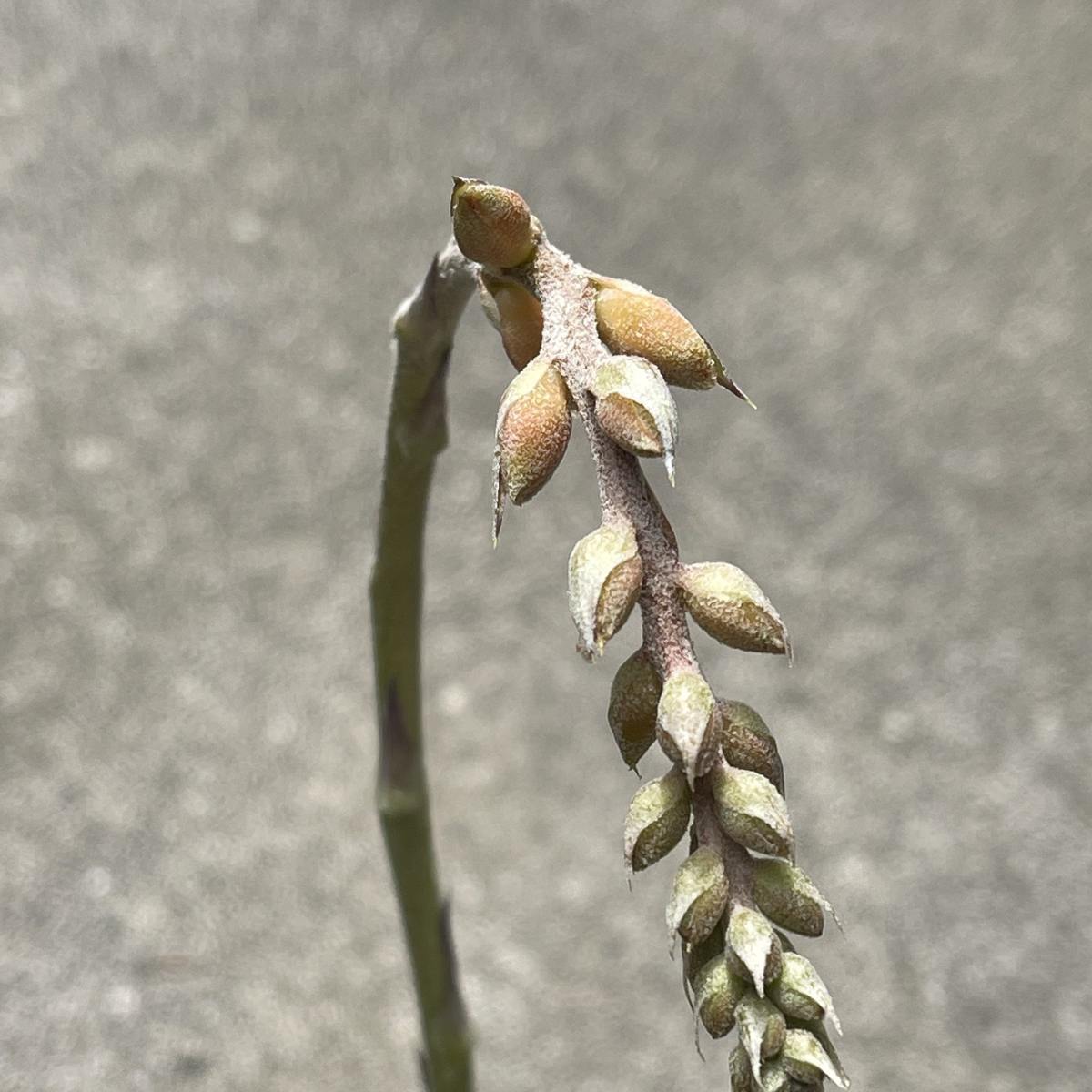
The memo of 4 July 2023 also carries a warning about the scape: it felt “very soft and fragile” — less brittle once it had grown out, but still delicate, still fresh and easily damaged. The same memo calls the plant overall “somewhat hairy,” which reads as our bench-level version of the description's covering of grey scales (see “Trichomes”). It also records nectar seeping from several points on the sides of the petals, and a bee visiting the flower — the flower-and-insect link observed in our own growing area.
For cultivation, we list only what our own records show, not general advice. On soil, there is a September 2023 observation: small seedlings dusted over with peat moss (as a surface cover) turned plump — “プリプリになる,” they fattened up. The seasons leave two kinds of record: the plant colouring up in spring (March 2023), and, repeatedly, plants knocked about by cold damage and sunburn (March 2026). A species from highlands at 1,300 m and above still does not pass Kochi's winter cold and strong sun unmarked — that is as far as our record lets us say. The wider picture is in “Growing Dyckia.”
SourcesSOURCES
Our own records (posts on both accounts, @togenot.kochi and @barracude, Instagram feeds and Threads, 2022–2026; the year of first flowering rests on the flowering memo of July 2023). IPNI (International Plant Names Index): the record of the name Dyckia monticola (Sellowia 14: 104, 1962). POWO (Plants of the World Online, Royal Botanic Gardens, Kew): accepted name and distribution (southern and south-eastern Brazil). World Flora Online (wfo-0000400782): the Flora Neotropica descriptive text and the Flora do Brasil 2020 morphological data. Smith & Downs, Flora Neotropica (the Pitcairnioideae monograph): description; distribution “open slopes, 1250–1500 m alt., Minas Gerais and Santa Catarina.” Büneker et al. (2020), Flora do Brasil 2020 / Flora e Funga do Brasil, Dyckia: the commentary (endemic to the rock outcrops and escarpments of the Campos do Quiriri; the epithet refers to the mountainous region of occurrence; separation from its relatives by the inflorescence), confirmed distribution Santa Catarina only, voucher specimens (Reitz 3938 and 4789, among others). The extent and elevation of the Quiriri highlands (spanning Campo Alegre, Garuva and Joinville, 1,300–1,600 m) follow published information from the municipality of Campo Alegre and others. The text of the protologue itself (Sellowia 14: 104, 1962) could not be opened for this note; the descriptive statements above are as confirmed in the later floras listed here.
Researched: October 2026