
NOTES — RESEARCH NOTES
Trichomes
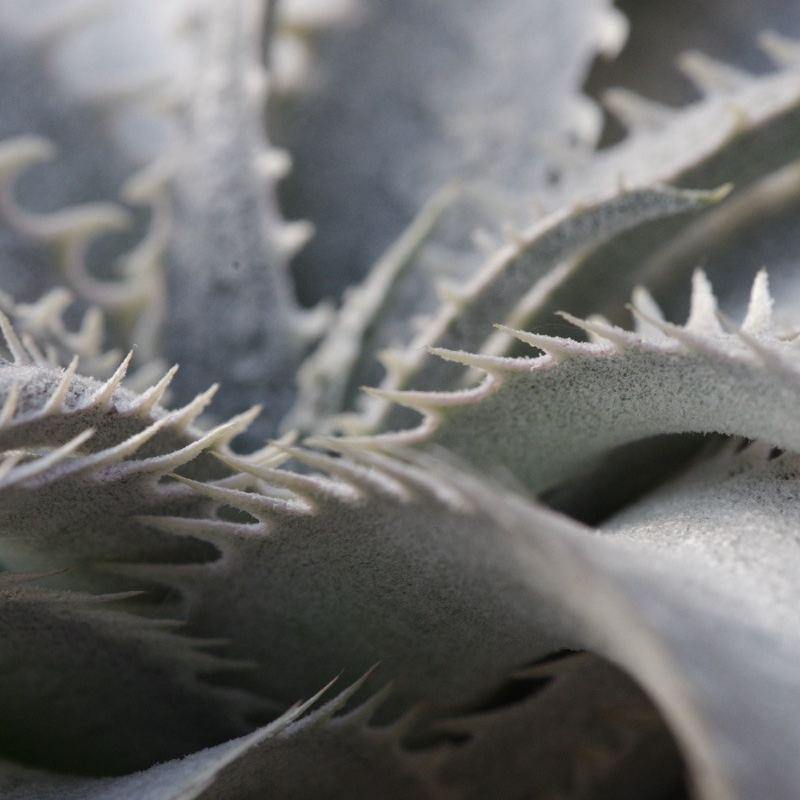
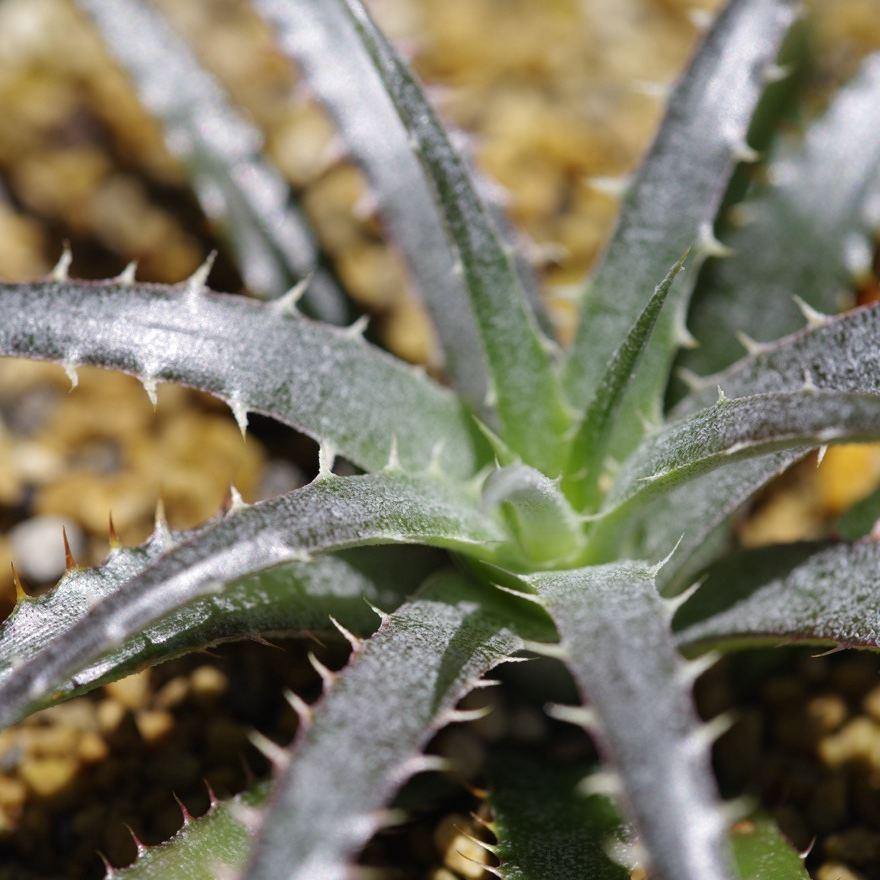
The silver-white of a Dyckia is not the colour of the leaf itself. The leaf surface is covered with shield-like hairs called trichomes — scale trichomes — and it is their whiteness that we see as the colour. In our own archive, 191 of 243 pages carry the colour tag “white / silver-white”; the silver is the main character of this collection. This note sets out what research has established about the structure and functions of trichomes, and how light and water change the white, against our own records (from both our accounts, @togenot.kochi and @barracude) and the trial records of fellow growers. “Trichome” is the general word for plant hairs; the bromeliad kind spreads like a scale, hence “scale trichome”. Growers in Japan often call it simply “powder”, and English hobby writing calls it scurf.
The StructureTHE STRUCTURE
A bromeliad trichome is a multicellular, umbrella-like structure. Seated in a depression of the epidermis is a short stalk of living cells, and on top of it a “shield”: a single layer of dead, empty cells. The shield is built of four central cells, concentric rings of cells around them, and an outermost “wing” (Benzing's description of the family ground plan).
In Dyckia, these scales are gathered in the grooves between the veins on the underside of the leaf, covering the stomata that sit in the same grooves (anatomical studies of Dyckia distachya and Dyckia brevifolia). The sheath at the leaf base carries neither scales nor stomata. How far they spread over the upper surface varies by species; a study of the selloa complex reports numerous trichomes on both surfaces.
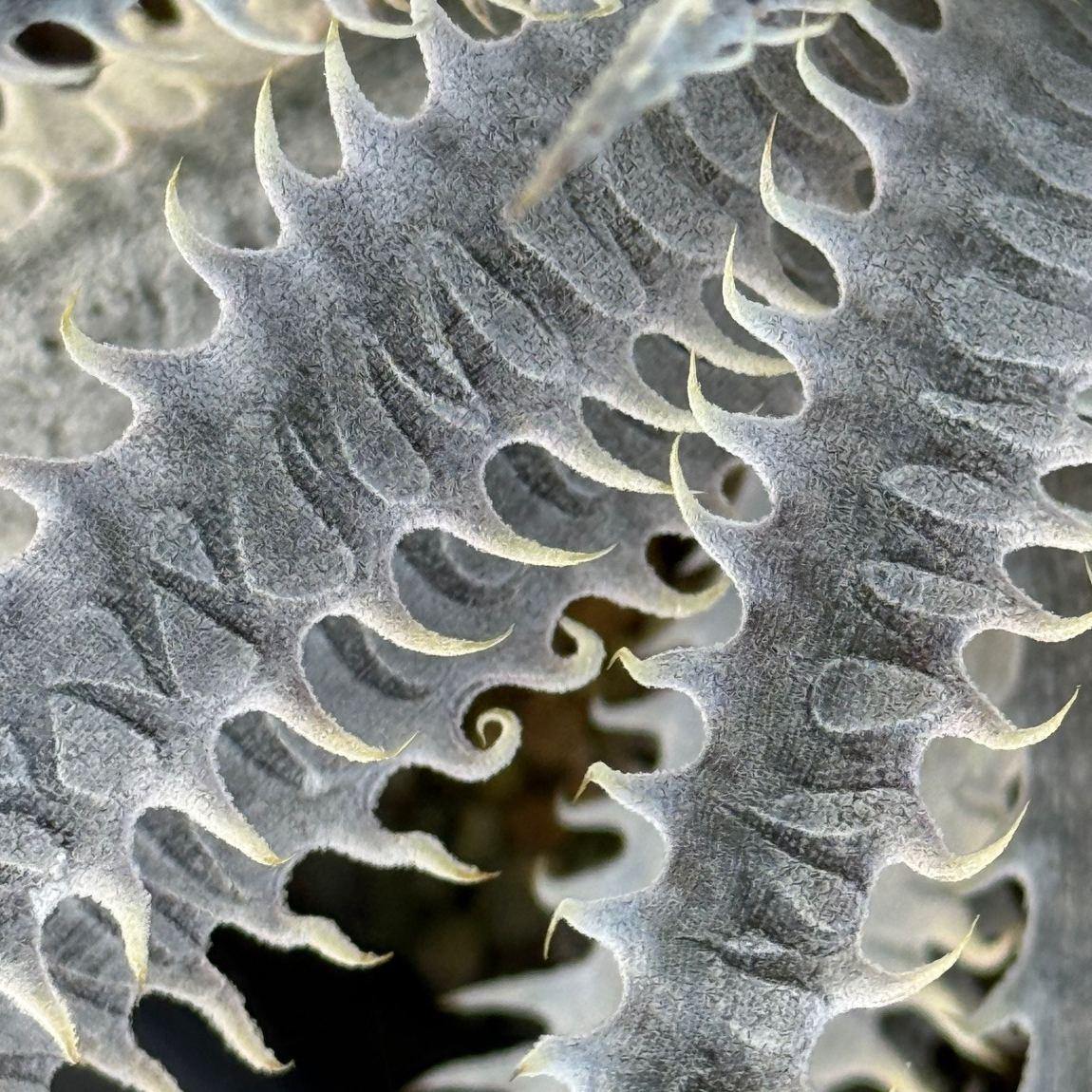
A dry shield is full of air and scatters light in all directions — that is why it looks white. When wet, water enters the shield in place of the air, light passes through more easily, and the ground colour of the leaf shows through. Our own records include a ‘White Shark’ that ended up baring its ground skin in the rain (August 2023), and many photographs deliberately taken of the plants wet, across both accounts. Wetting is not uniform: the water-shedding surface of one species (Dyckia platyphylla) has been measured, while our own observation also finds superbly water-repellent plants and plants that go matte (April 2023).
What They DoFUNCTIONS
The evidence behind the proposed functions is uneven. What has been shown in Dyckia itself is kept separate here from what is only family-level general knowledge.
For Dyckia's anatomy, the leading reading is light refraction and water economy. A study of the selloa complex, citing earlier work, puts forward the hypothesis that the main role of trichomes in Dyckia is not absorption, but refracting light and conserving water. The scales cover the stomata inside their grooves, holding a layer of air at the leaf surface and holding back transpiration through the stomata (the brevifolia study). Together with a thick cuticle (the thin, waxy film that coats the leaf surface and holds back water loss), this reads as equipment for life on rock outcrops under strong sun and drought.
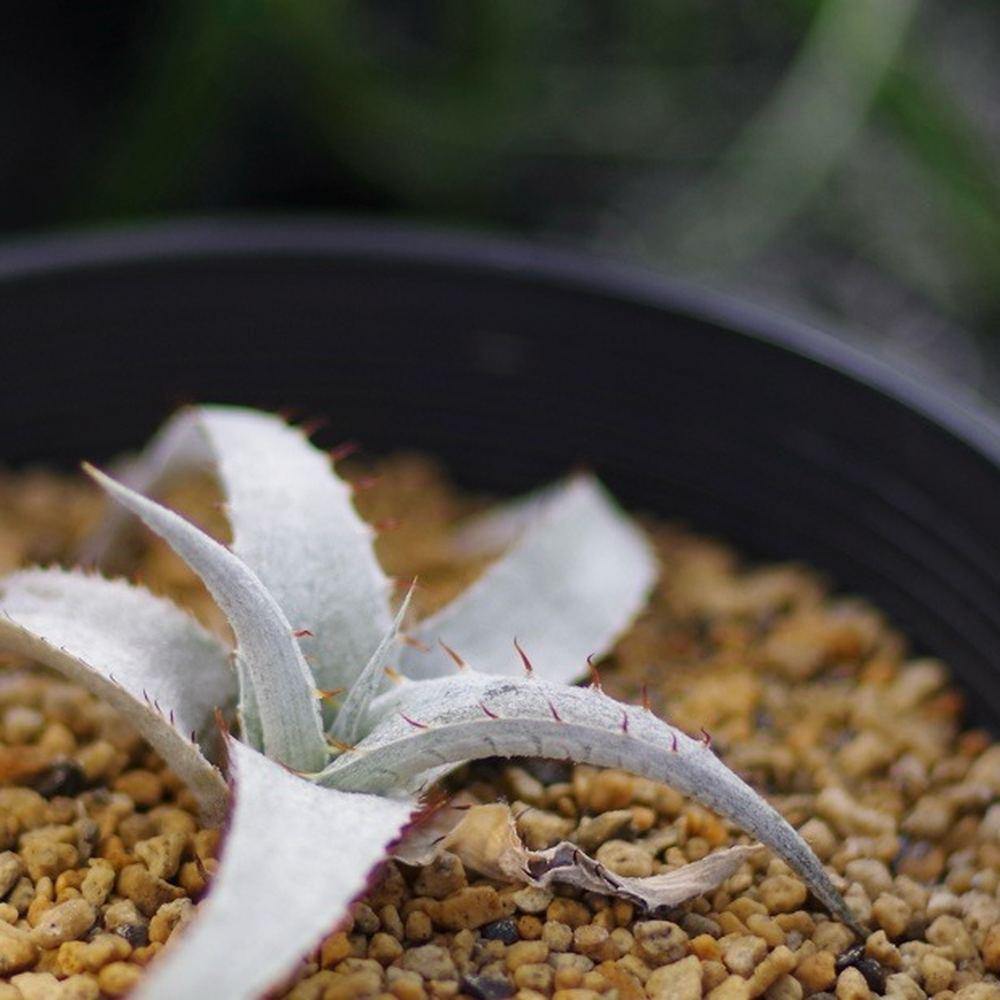
Across the family as a whole, though, trichomes are famous as the organs that “drink through the leaf”. In Benzing's classic work, a wetted shield fills its dead cells with water, passes it to the living stalk cells, and, on drying, closes the vapour path so the water is not lost again — a one-way valve. For atmospheric tillandsias that live on airborne moisture, and for tank bromeliads, this is a lifeline. But Dyckia is terrestrial, with proper roots and no tank. Water uptake belongs to the roots, and treating trichome absorption as the main story in Dyckia is, in our view, the family generalisation stretched too far.
In riverside species that are flooded at high water (brevifolia, distachya), the thick cuticle and the scale cover over the stomata are also read as waterproofing, keeping water out. The same structure thus faces both ways: against drying out in dry settings, and against water getting in when submerged.
Family reviews also list defence against herbivores and insulation against sudden temperature change among the functions. No study is known that tests these directly in Dyckia.
Changed by the EnvironmentCHANGED BY THE ENVIRONMENT
Trichomes are not a finish applied once. They keep being made on every new leaf, so when the environment changes, it is the whiteness of the new leaves that changes. Our records show how.
The link with light is in our own records too: a record noting that enough sun has to be secured (March 2023, @barracude) — the white and the light cannot be separated. Yet under about 40% shade some plants still stood out whiter (‘Throwing Star’ and ‘Nanda Devi’, June 2023); how much light each plant needs differs. The seasons show too: a ‘Richard Kaz’ white form that put on an even fuller winter white (January 2023), and a ‘Silver Mercury’ recorded in March — the records show the white increasing in the cold season.
The other loss is physical: trichomes that are already there can be knocked off. Our records include a plant whose powder “flakes off extremely easily” (March 2023); touch and rubbing will take it off. What is washed or rubbed off is temporary, and returns as the surface renews. “Coming off” and “no longer being made” may look alike — their causes are different.
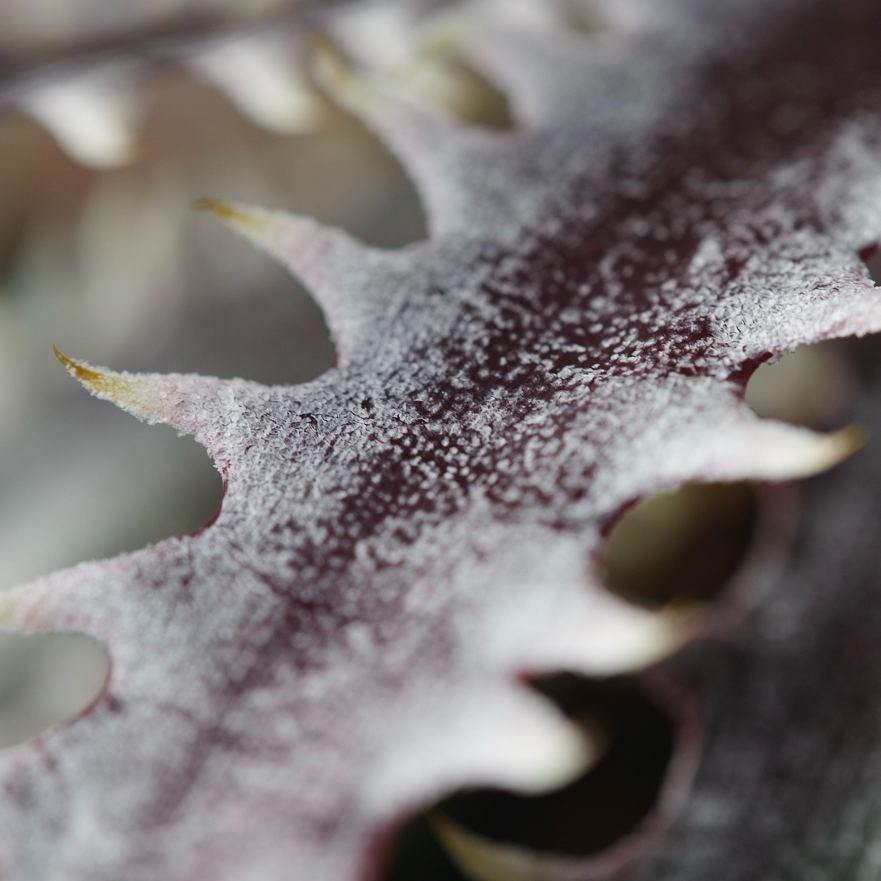
Amount and texture also differ plant by plant. Dyckia monticola is on record as “somewhat hairy overall” (July 2023), and one unnamed Brazilian species carries “dust-like trichomes” (April 2023). On young leaves, a trichome pattern can remain along the imprint of a spine (July 2023). And the silver is inherited: among our own crosses, one seedling kept the “metallic silver skin” of its seed parent (‘La Rioja’ × brevifolia, April 2025).
HandlingHANDLING
To keep the white, first: do not touch it. Easily shed powder comes off merely from holding the leaves while repotting or moving a plant. Move the pot, not the leaves.
For watering, plants whose powder you do not want wet can be kept on bottom watering — we do this ourselves (April 2023). Our line is to use bottom watering for limited purposes, not as the standing method; the details are in “Growing Dyckia”, in the section on bottom watering. When watering from above, give the water at the base of the plant, without rubbing the leaf surface (the water section of the same note).
A wet plant showing its ground colour is not a plant whose trichomes have melted or broken. Once dry, the shields fill with air again and the white returns. If, instead, the new leaves themselves stop coming out white even when dry, that can be a sign to look again at the light and the water.
SourcesSOURCES
Our own records (posts on both accounts, @togenot.kochi and @barracude, Instagram feeds and Threads, 2023–2026). Benzing's bromeliad research ("Bromeliaceae: Profile of an Adaptive Radiation", 2000, and related work; on trichome structure and the valved movement of water). Troleis et al. (2023, Acta Botanica Brasilica; leaf morphoanatomy of the Dyckia selloa complex — the source of the function hypothesis cited above). Voltolini et al. (2009, Revista Brasileira de Biociências; leaf morphoanatomy of Dyckia distachya). A study of the leaf epidermis of Dyckia brevifolia (2013, The Scientific World Journal). A study of the leaf surface and wettability of Dyckia platyphylla (2019, IOP Conference Series).
Researched: October 2026