
NOTES — RESEARCH NOTES
Reading Spines and Form
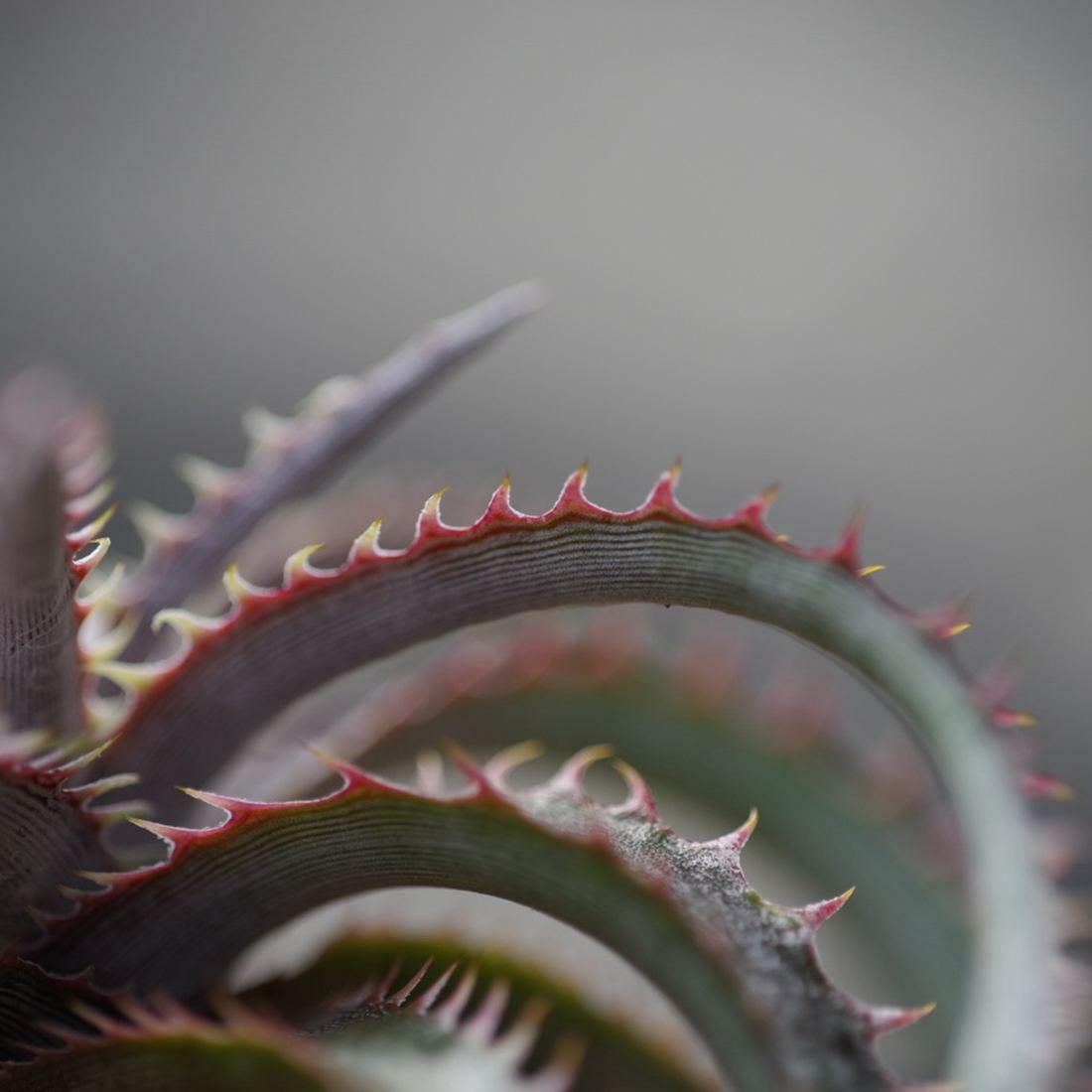
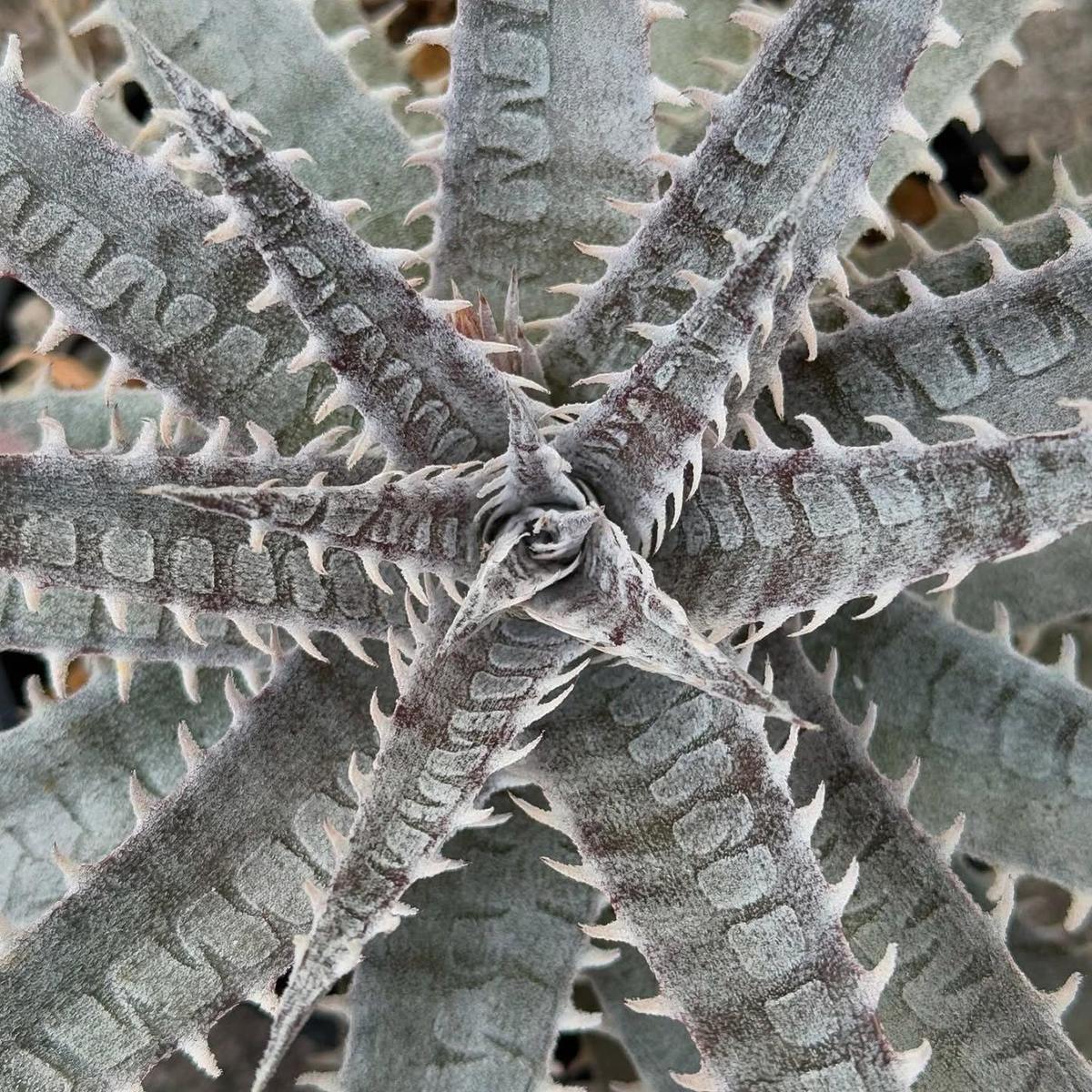
A Dyckia's name often cannot be settled without flowers. Even so, for anyone watching plants day to day, identification starts with the leaf — above all with the spines (the “teeth”) along its margin. Protologues and flora keys do in fact use the spines again and again, with measurements: their shape, spacing, direction, colour and rigidity. This note sets out, from the sources, which characters taxonomy relies on and which it does not, and lays our own records (from both accounts, @togenot.kochi and @barracude) alongside. The second half gives the working vocabulary we use to record spine form in this archive. These are our house terms for keeping records consistent — not established taxonomic terminology.
What to Read FirstWHAT TO READ FIRST
The clues have an order of strength. Spines, leaf, rosette and trichomes, in that order, with how each is used in taxonomy.
Spines
The most trusted vegetative character. The genus description in Flora do Brasil (2020) sums up the marginal spines as flattened-triangular to needle-shaped, straight or usually hooked, retrorse or antrorse, rarely patent.
The keys add numbers. The two varieties of Dyckia fosteriana are split by the spacing of the spines at the middle of the leaf — densely set, less than 5 mm apart, against lax, more than 7 mm apart — and Dyckia maranhensis and Dyckia paraensis are split by spine colour (black against brown), length, and spacing (4.4–8.2 mm against 18–25 mm).
Colour counts elsewhere too: the flora separates Dyckia frigida from the similar Dyckia encholirioides partly by its black marginal spines (against brownish-green). Direction as well: Dyckia glabrifolia is distinguished from Dyckia weddelliana in part by antrorse against retrorse spines.
Rigidity is a character as well. Dyckia delicata closely resembles Dyckia hebdingii, but its protologue (2002) named it for its soft, non-injurious spines — “the most evident and readily verifiable character of the species”. Yet even that protologue's key does not decide on spine texture alone: it sets inflorescence branching and indumentum, and seed shape, beside it. Spines are a strong clue, but the describers do not treat them as a sole decider.
Leaf
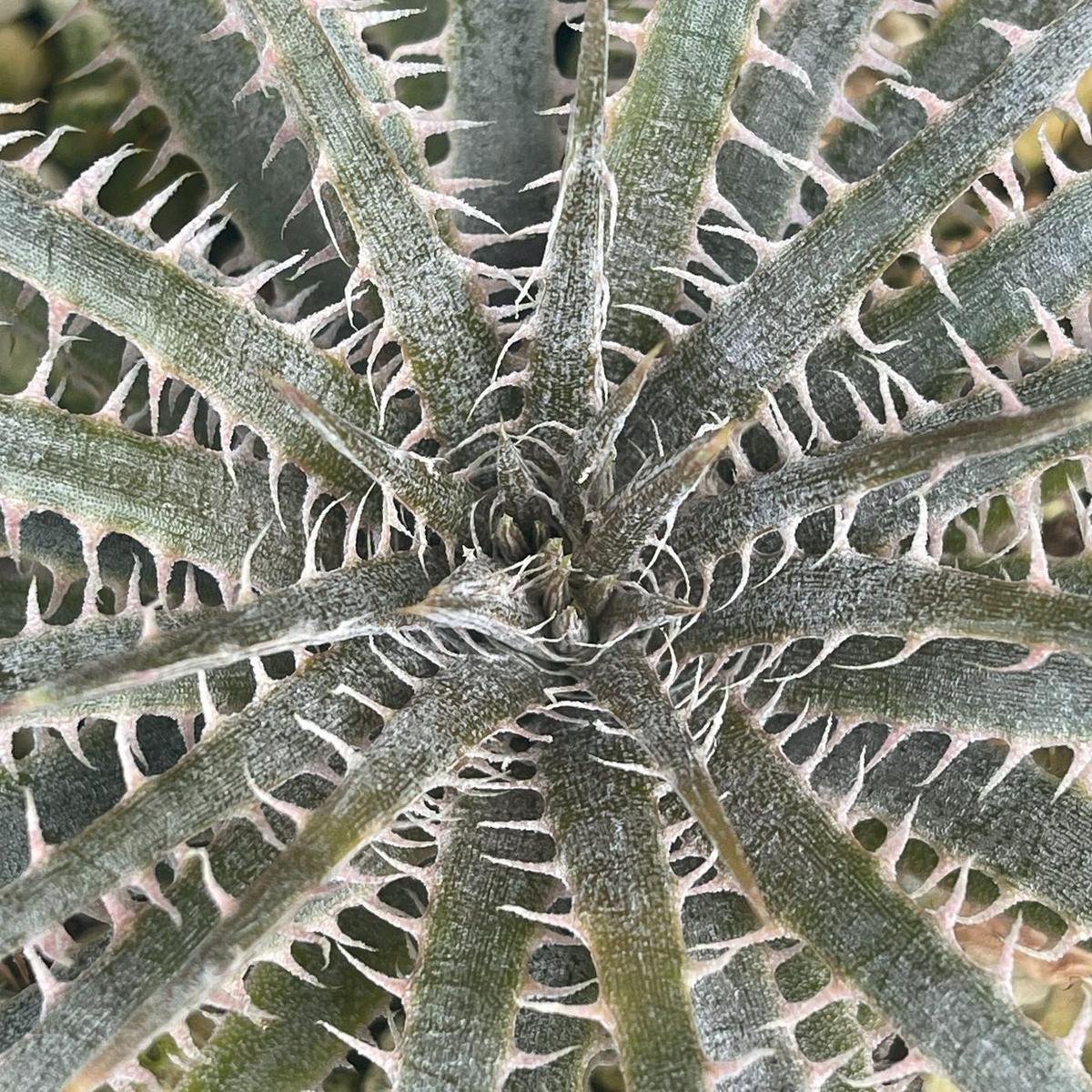
Blade shape (narrowly triangular and the like), width, thickness, and the longitudinal striping of the underside — written in descriptions as an abaxial face “longitudinally nerved-striate”, the stripes we watch at home as the leaf's back-lines — are description staples.
The cross-section carries characters too: an anatomical study of the selloa complex lists the presence of water-storage and mechanical tissues, stomatal position — and spine colour — among the characters that help delimit its species. But a cross-section belongs to the microscope; in cultivation it can only be read indirectly, as leaf thickness and the depth of the upper channel.
Rosette
Symmetry, the stacking of the leaves, and tightness are sometimes used for field identification (in Flora do Brasil, rosette form is one of the differences listed for Dyckia macedoi against its relatives). But the rosette is also the part that changes most with light, pot and water, as the next section shows. Alone, it is the least reliable clue.
Trichomes
The density and conspicuousness of the scales enter the keys as well (the fosteriana varieties are also split by whether the upper surface's scales are conspicuous). In the 2023 description of Dyckia magnifica, even the shape of the marginal trichomes — finger-like against thread-like — serves to separate it from Dyckia tomentosa.
The amount of hair, however, changes with the environment; the details are in “Trichomes”. A supporting character, then — rarely a decider.
And the limits are stated plainly in the sources. Dyckia tomentosa and Dyckia hebdingii are “morphologically very similar”, differing basically in size at flowering, inflorescence size and branch number, and the direction of the stigma lobes — flowers and overall size, not leaves. Dyckia fosteriana against Dyckia monticola is, in the flora, basically a matter of the inflorescence (simple against compound) and the floral bract margins. Some identifications genuinely cannot be settled from leaves.
A Working Vocabulary for SpinesA WORKING VOCABULARY FOR SPINES
The wish that spine shapes had names, so they could be recorded, is heard among Japanese growers too. In this archive, to leave the differences between plants in words, we have sorted spine shapes into a few groups. They are strictly our working terms, not established taxonomic terminology. The English on the right, however, is aligned with the descriptive words the protologues and the flora actually use — so that naming things at home does not drift away from the language of the descriptions.
| Straight | Uncurved to the tip. In descriptions: straight. |
|---|---|
| Hooked (claw) | The tip bends over like a hook or claw. In descriptions: hooked (aduncate) — the word the Flora do Brasil genus description uses. The form our records have long called the “key-claw type”. |
| Forward | Leaning toward the leaf tip. In descriptions: antrorse. |
| Backward (barbed) | Leaning toward the leaf base. In descriptions: retrorse. Slide a finger toward the leaf tip and it catches — the “strong barb” feel is this direction combined with a hook. |
| Spreading | Standing out from the margin at nearly a right angle. In descriptions: patent — the posture the Dyckia magnifica description uses against its relative's hooked spines. |
| Dense / lax | The spacing of the spines at the middle of the leaf. The flora's keys measure it in millimetres, and we record it as a number too. |
| Rigid / flexible | How the spine bends, and how it pricks, to the touch. Dyckia delicata's “soft, non-injurious” is the description-language example. |
| Colour | White, black, brown, green and so on. Base and tip often differ, and descriptions write them separately — “whitish-green at the base, yellowish brown at the apex”. |
| Direction — a caution | It mixes within a single species: the delicata protologue describes the same species' spines as “straight, retrorse or antrorse”. Direction is a tendency to be read across several leaves, never a verdict from one spine. |
Form That MovesFORM THAT MOVES
Flora do Brasil says in its genus commentary that Dyckia taxonomy is “notoriously complex”, that the characters used to delimit species are “subtle, and sometimes unstable”, that widely distributed species show “significant morphological plasticity (especially vegetative)”, and that natural hybrids are not rare. Form moving with the environment is, in other words, the flora's own caveat — not a grower's illusion. The movements that overlap our records:
Spacing moves
The very spacing the keys measure in millimetres can change with watering. In a Japanese grower's bottom-watering trial (2021), the group kept on bottom watering showed, alongside thinning trichomes, a widening of spine spacing (a single grower's trial, with his own caveats; details in “Trichomes” and “Growing Dyckia”).
Read spacing without the plant's watering history, and the same plant can read as a different species.
Tightness moves
Without enough light the rosette stretches open (our records, August 2023); a plant whose light was sacrificed to its powder took on a “scissored-open” look (March 2023); and in humid spells, one line's leaves are recorded curling “like unruly hair” (February 2024).
Rosette tightness and leaf waviness record the environment the plant sits in — they are not the plant's bare face.
Faces change with the season
Our archive holds the same individual photographed in its winter and its spring form (‘Chicago’, January and April 2023). Colour contrast, and how the spines read, both move with the season. That is why we keep recording each plant across the year (the Archive).
Exceptional plants appear
In the line of Dyckia ‘Sky Walker’, a spineless sport emerged, recorded with only three teeth grown (February 2023). Sports and young plants are not the standard face of a species or cultivar. Identification belongs to several mature leaves — and, where possible, to the flowers with them.
From Our RecordsFROM OUR RECORDS
Finally, the cases in our own records where reading spines and form actually happens. All are observations left in posts on the two accounts.
Regularity is itself a character. We recorded ‘Sawfish’ in our earliest days for spines that stayed “regular as mathematics” even in poor light (January 2023). Dyckia goehringii is the species we have written of again and again as “all about the spines” — its rows of white spines are the centre of the summer records (July–August 2023).
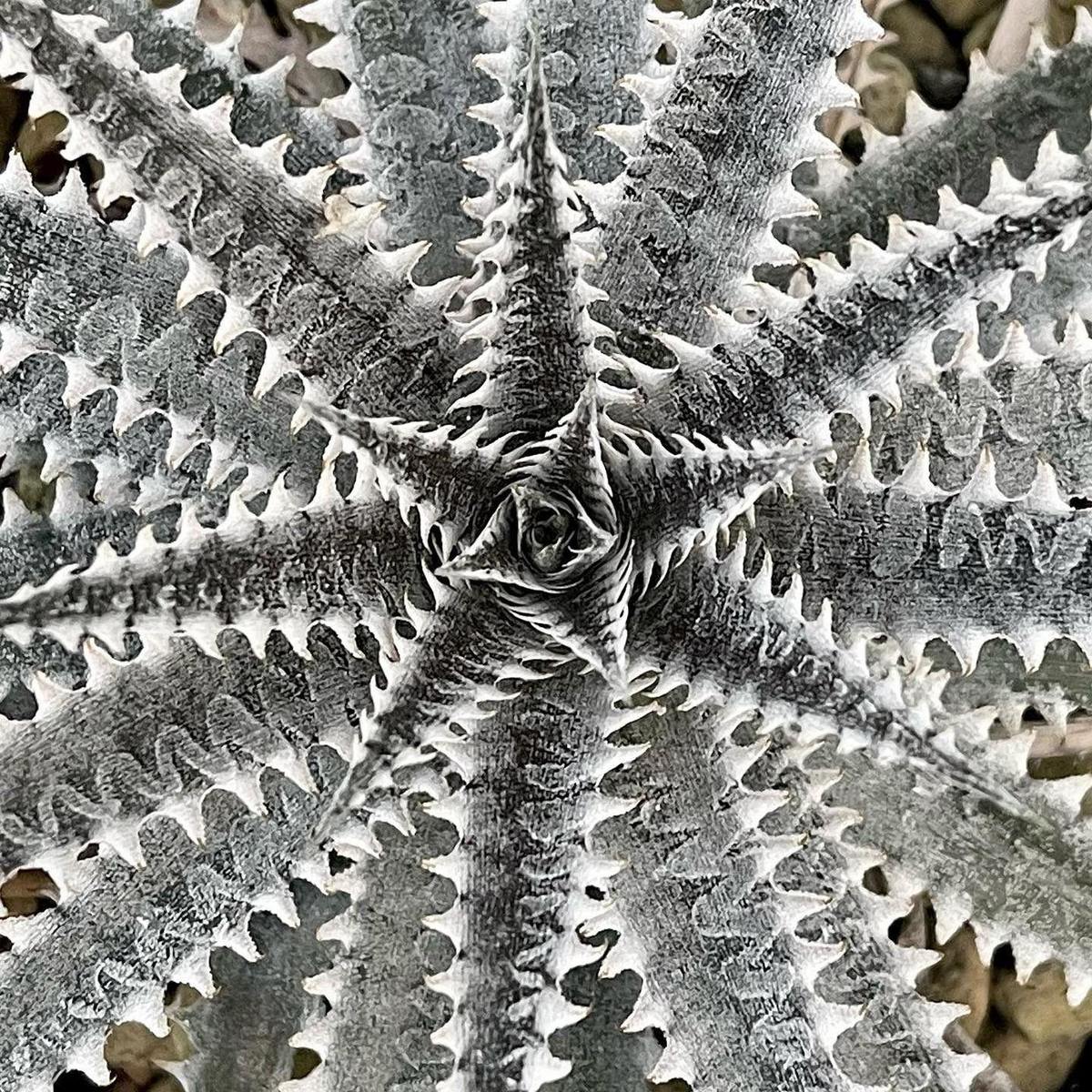
Even pain carries information. The spines of Dyckia monticola are recorded as the most painful among our plants, strongly barbed, the wound widening as you move (February 2023) — what hooked, backward-leaning spines do to a hand, felt directly. Within one seedling grex, by contrast, seedlings split into modest-spined and otherwise, with the back-stripes differing too (July 2023). A grex cannot be represented by a single seedling.
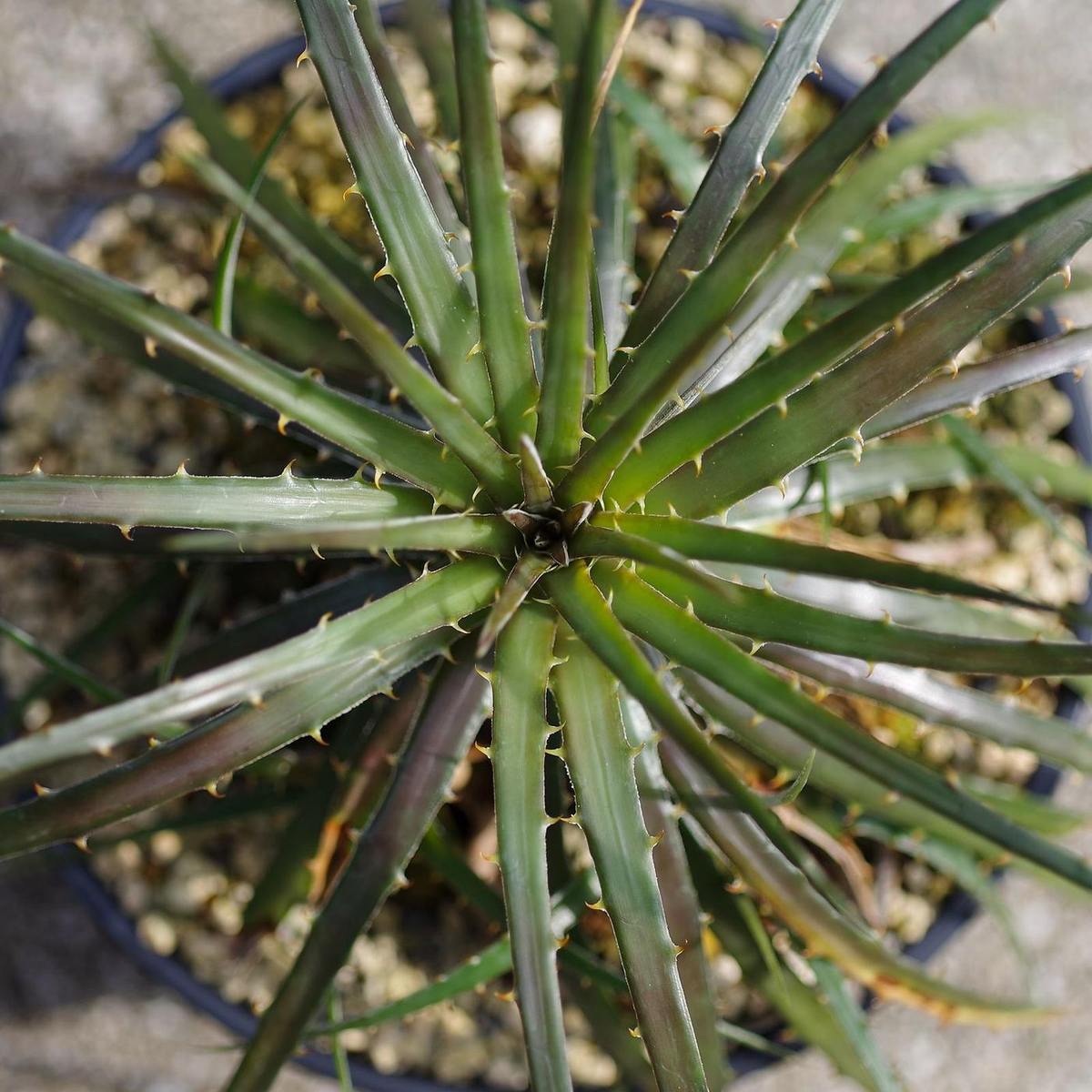
In breeding, too, spines are a target character. For our cross ‘Jaws’ × Dyckia choristaminea (crossed 2022) we record thin leaves and “hook-claw teeth, more numerous and more regularly set than the default” (April 2023). In ‘La Rioja’ × Dyckia brevifolia, a seedling kept the seed parent's metallic silver skin while its once-irregular spine spacing looked corrected by the pollen parent — recorded together with spines like a small beetle's legs (April 2025). And the “special spines” line of Dyckia fosteriana has served as pollen parent again and again from 2023 to 2026: asking the parent for spine quality is one of the axes of our crossing.
We watch the undersides, too. The stripes on a leaf's back, and the imprint a neighbour's spine leaves on it, never appear in a top-down photograph; we have recorded them from a looking-up angle (July 2023). For registered cultivars as well, our position is that photographs of the underside ought to be added.
SourcesSOURCES
Our own records (posts on both accounts, @togenot.kochi and @barracude, Instagram feeds and Threads, 2023–2026). Büneker et al. (2020, Flora do Brasil 2020 / Flora e Funga do Brasil; the genus description, the regional and infraspecific keys, and the commentary on the genus's taxonomic difficulty and morphological plasticity). Larocca & Sobral (2002, Novon; the protologue of Dyckia delicata — the soft-spine description and the key against Dyckia hebdingii). Büneker et al. (2023, Phytotaxa; the description of Dyckia magnifica and the re-establishment of Dyckia tomentosa — separation by spine posture and marginal trichome shape, and on the similarity of Dyckia tomentosa and Dyckia hebdingii). Troleis et al. (2023, Acta Botanica Brasilica; leaf morphoanatomy of the Dyckia selloa complex — on cross-section characters). A Japanese hobbyist blog (two posts trialling bottom watering, April and May 2021; on the change in spine spacing).
Researched: October 2026