
NOTES — RESEARCH NOTES
Flowering Records
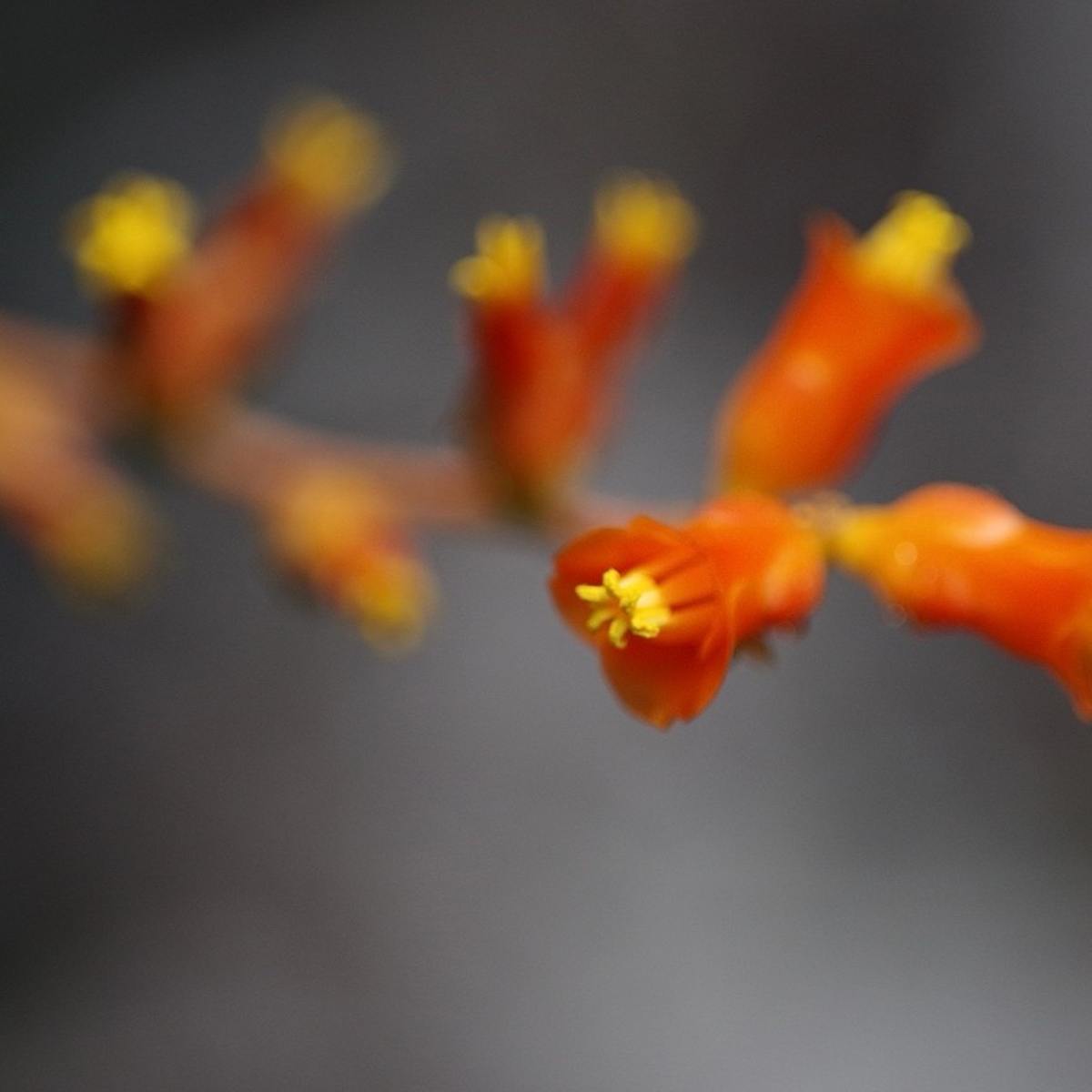
Dyckia is grown for the architecture of its leaves — but without flowers there is no crossing, and no selection. Since 2023 we have recorded flowering and budding with dates, here in Kochi. This note sets the basics of the flower, and what field studies say about its visitors, against our own record. It overlays our own flowering records in Kochi with the flowering and bud records for which the plant could be identified. Flowering records survive in greater numbers on @barracude, the day-to-day account, than on @togenot.kochi, which carries the cultivar records. When a Dyckia flowers is something only a kept record can show.
The FlowerTHE FLOWER
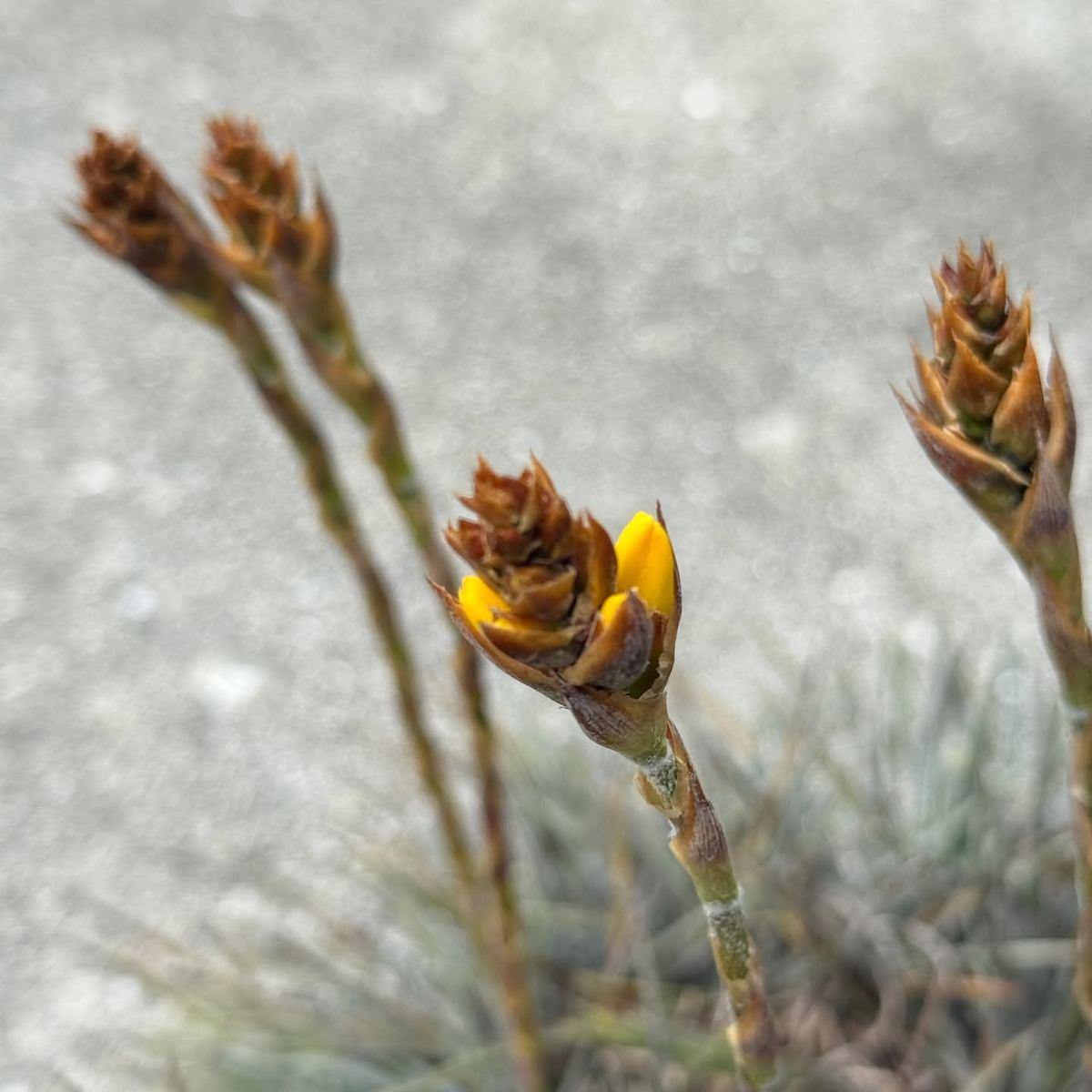
The inflorescence does not rise from the centre of the rosette, but from the side, at the base of the leaves. The growing point is not spent on the flower, so a rosette that has flowered does not die — it can flower again the next year. Inflorescences vary across the genus, from a single spike to a branched panicle. Among our own plants the range is visible too: the slim scapes of Dyckia monticola, the densely packed head of Dyckia choristaminea — “a bouquet on a single stem”, as one of our captions put it — and ‘Chicago’, which raised three scapes at its first flowering.
The flowers are bisexual and built in threes: three sepals (shorter than the petals), three petals, and six stamens in two whorls, joined at the base of the petals into a short tube. The stigma is of the conduplicate-spiral type. The position of the ovary is treated differently across the literature: current standard accounts of the genus describe it as half-inferior, while older accounts describe it as superior. Flower colour runs from yellow through orange to red, and wine-coloured flowers are reported in some species.
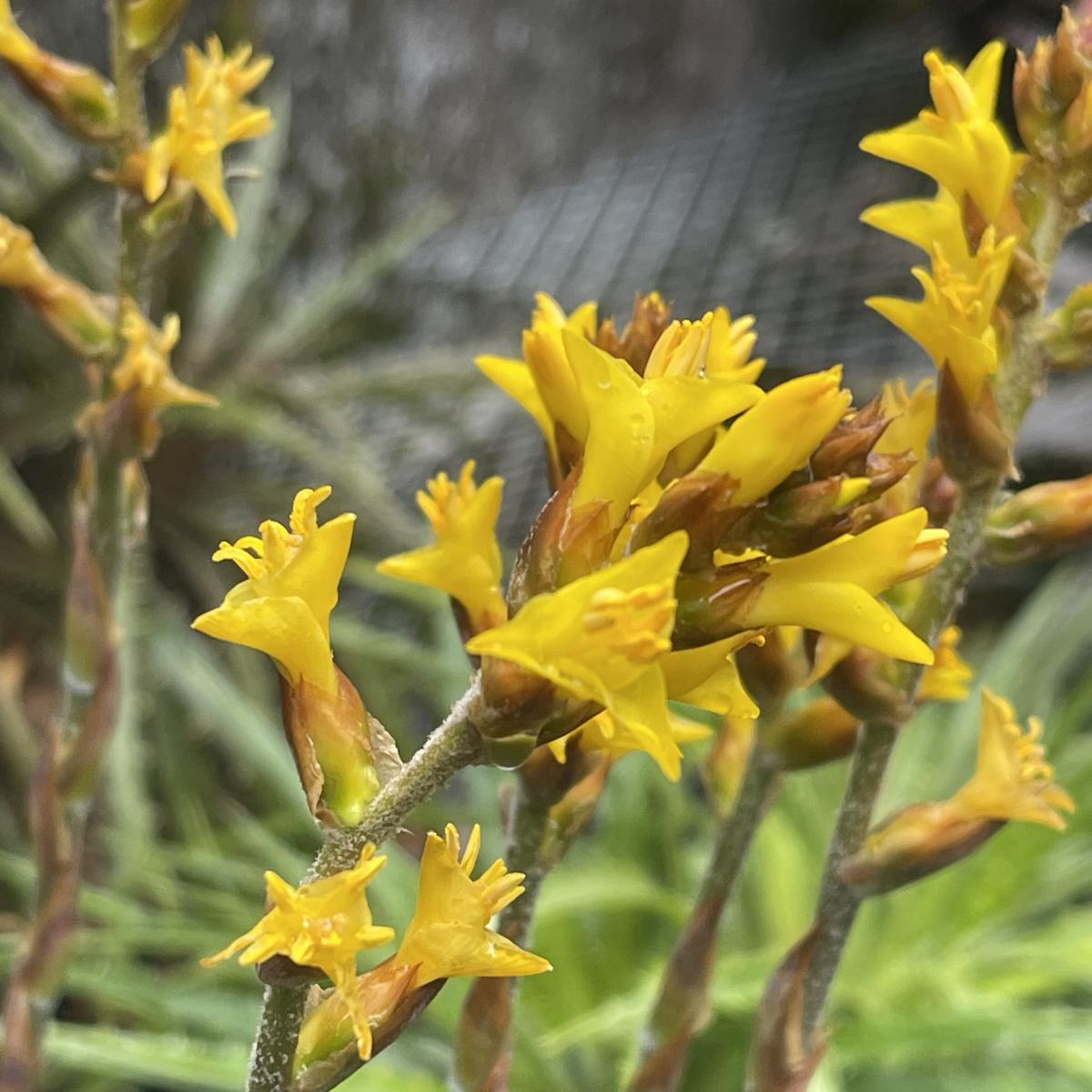
When our choristaminea flowered for the first time, we remember how, among the many orange flowers, its lemon-yellow petals looked so fresh and stood out all the more. (Around May 2023)
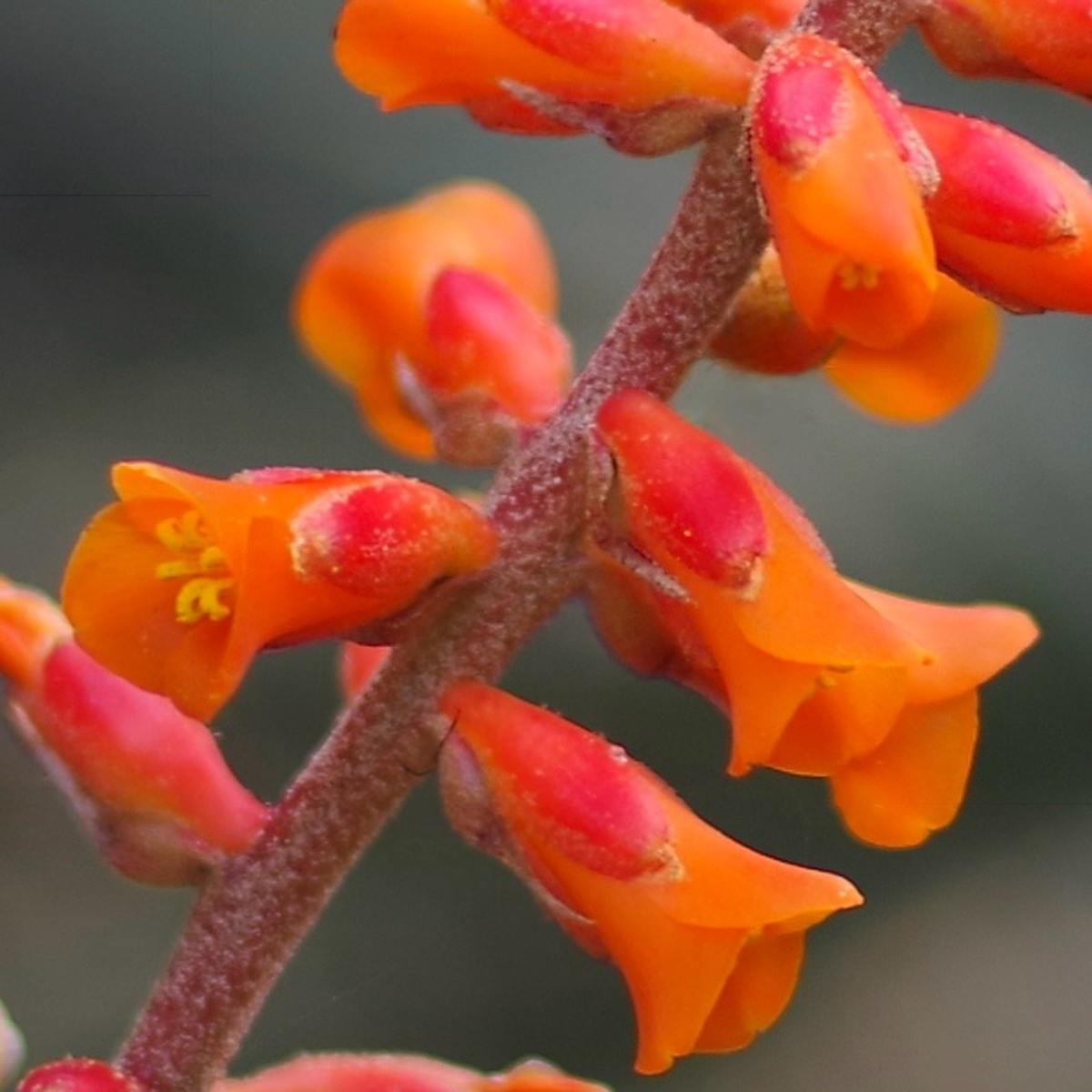
Flowers open in sequence, from the base of the inflorescence toward the tip. In a study of the riverside species Dyckia brevifolia, one inflorescence carried about 60 flowers, about 7 opened per day, and a single flower lasted roughly a day and a half. The flowers carry nectar — in that species about 30 microlitres per flower, at a concentration of about 26%.
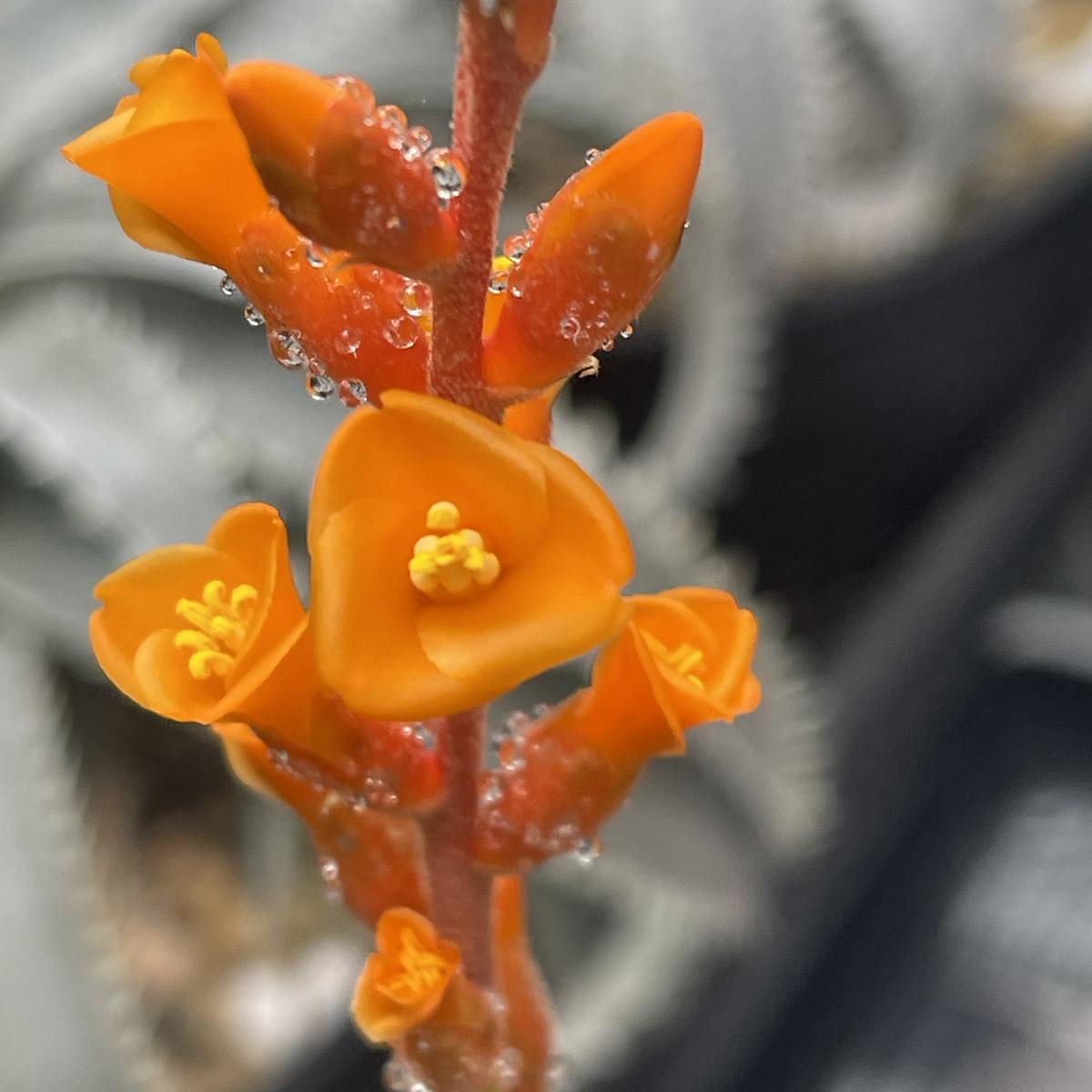
How much wells out differs from plant to plant, but nectar does seep from several points along the sides of the petals, and, as we take up below, natural crossing depends very heavily on insects. The same notes record how flower structure differs plant by plant — in that individual the stamens stayed clustered at the centre rather than spreading, and the pistil sat low, hard for its own pollen to reach. Some species also bear extrafloral nectaries on the outside of the calyx, which draw ants. As for the wait: a society guide gives “three or more years from seed to flower”, and our own crosses have likewise taken years, not months, to reach their first bloom.
The hour of opening also varies by plant. For goehringii × ‘Sky Walker’, we have a record of the flowers opening after nightfall (January 2024), and a record of flowers that opened at night also remains from March the following year (we had deleted the photos, and had not recorded the plant's name either). Flowers that open at night meet a different set of visitors — which connects to the field finding, below, that nocturnal visitors also carried pollen in Dyckia scrutor.
A Flowering Calendar in KochiA FLOWERING CALENDAR IN KOCHI
Counting the plant-identified records of flowering and budding across the posts of both accounts — @togenot.kochi and @barracude, on Instagram and Threads — and our cultivar pages (2023–2026), month by month: A busy month reflects a real concentration of flowering — but a month with no records does not mean nothing flowered. Only what reached a post is counted.
| January (6) | ‘Classic One’ in flower (2023); goehringii × ‘Sky Walker’ and sp. ‘Robson’ green form (2024); buds on ‘Engawa’ and flowering of estevesii (2026), among others |
|---|---|
| February (2) | Buds on a marnier-lapostollei relative (2024); goehringii New Form F1 in flower (2026) |
| March (3) | Buds on delicata × ‘Bangkok Star’ (2023); ‘Nanda Devi’ and ‘Chicago’ in flower (2026) |
| April (9) | delicata × ‘Bangkok Star’ in flower and a scape rising on ‘Heaven and Hell’ (2023); buds on ‘Jaws’ (2024); first flowering of ‘Yeti’ (2025); ‘Engawa’, ‘Avalanche’ and ‘O-J’ in flower (2026), among others |
| May (16) | The peak — a third of all records. choristaminea, frigida, monticola, ‘Heaven and Hell’, ‘Obsidian’, ‘Jaws’ and more (2023–2026) |
| June (3) | ‘Heaven and Hell’ (2023); monticola (2024, 2025) |
| July (5) | monticola and buds on frigida; flowering and seed harvest of choristaminea rubra (2023); magnifica in flower (2025) |
| August (1) | monticola (2026) |
| September (1) | pectinata rubra (2026) |
| October (3) | ‘Distortion’ (2023); a second flowering of estevesii and buds on sp. ‘Robson’ (2024) |
| November (0) | No plant-identified record. A post from November 2023 does note plants beginning to raise buds, but the plants were not named |
| December (1) | A second flowering of ‘Nanda Devi’ (2025) |
The pattern is a spring concentration — May first, then April — with November the only month holding no plant-identified record. Years differ, too: after the warm winter of 2025, the number of buds was the largest in our records, to the point that they were cut week after week.
How buds rise also shows plant-by-plant tendencies, and we have the impression that warmer weather brings buds up earlier. Field studies show flowering time moving with species and habitat: Dyckia excelsa flowered mainly in September (early spring in the southern hemisphere) on its ironstone outcrops, and Dyckia erectiflora flowered at the transition from the rainy to the dry season, with flowering not correlated with rainfall. In other words, there is no single “Dyckia month” for the genus — under cultivation, the answer has to come from local, plant-by-plant records. This is strictly our own environment, shaped by Kochi's climate and by the plants we grow.
Repeat Bloomers & Out-of-Season RecordsREPEAT BLOOMERS & OUT-OF-SEASON RECORDS
The most recorded plant is Dyckia monticola: five flowering records across four consecutive years, 2023–2026. The month, though, drifts — July, May, June, June, August — so even a faithful bloomer does not keep a fixed month. ‘Heaven and Hell’ has flowering records in 2023 and 2025, and ‘Yeti’, after its first flowering in 2025, flowered again in 2026. choristaminea and ‘Jaws’ also have flower records across multiple years.
Some plants have flowered twice in a year: estevesii reached its second flowering in October 2024, and ‘Nanda Devi’ in December 2025. The time from bud to bloom also depends on the plant — on some, nearly three months pass between the scape stretching out and the flowers opening.
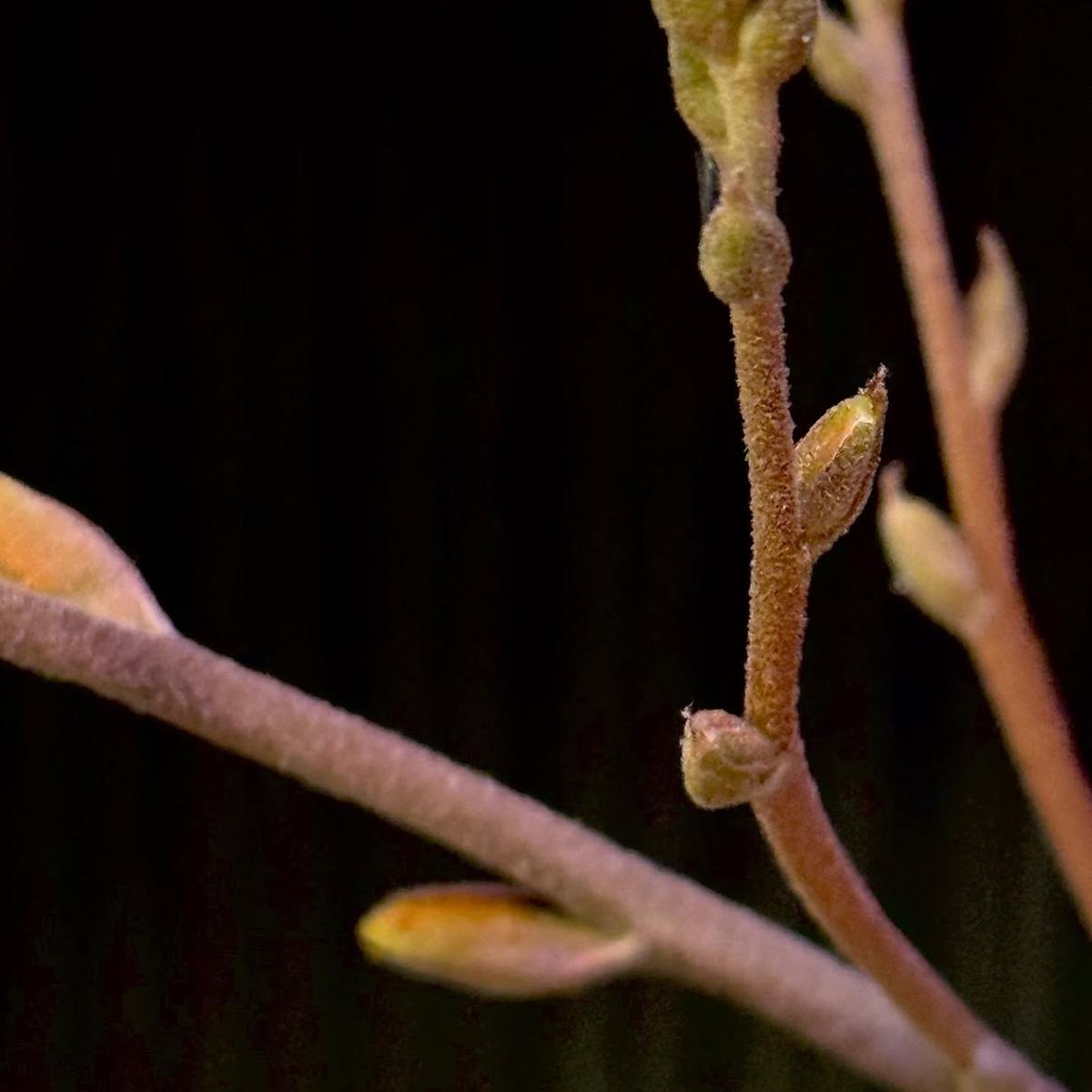
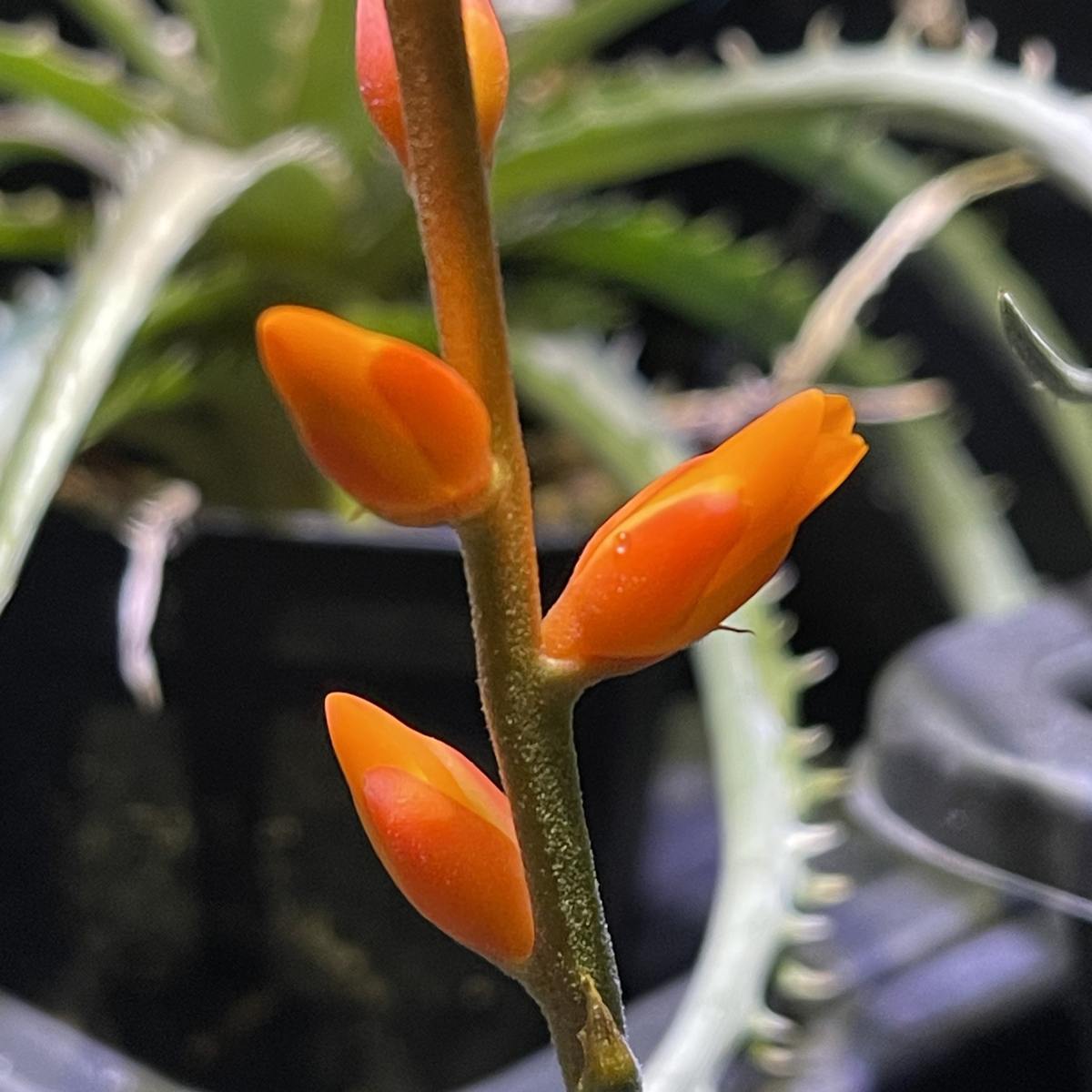
Midwinter records stand out: nine records fall in December–February, including estevesii flowering in a cold wind in January 2026 and ‘Classic One’ in flower in January 2023. The same ‘Classic One’, after raising its bud and flowering in winter, was damaged left out in the rain, lost its leaves, and started over (recorded July 2023). In December 2024 there were also plants that raised buds but never opened within the year. Kochi's mild winters, and the practice of moving plants under eaves or indoors, are both likely reflected here — we state this as a tendency of our own record, no more.
Visitors & PollinationVISITORS & POLLINATION
In the field, Dyckia flowers are visited by hummingbirds, bees, and butterflies. For Dyckia brevifolia, the hummingbird Amazilia versicolor was the main pollinator, with carpenter bees, bumblebees, and butterflies also visiting. Dyckia excelsa likewise received hummingbirds, bees, and butterflies — its flowers show the hummingbird syndrome, yet the actual visitor list is broad. In the endangered Dyckia scrutor, daytime visits by a hummingbird and a butterfly mattered most for seed production, and nocturnal visitors also carried pollen.
There are exceptions: in Dyckia erectiflora, pollination centred on exotic bees, which the researchers describe as unusual for a genus built mainly around hummingbirds.
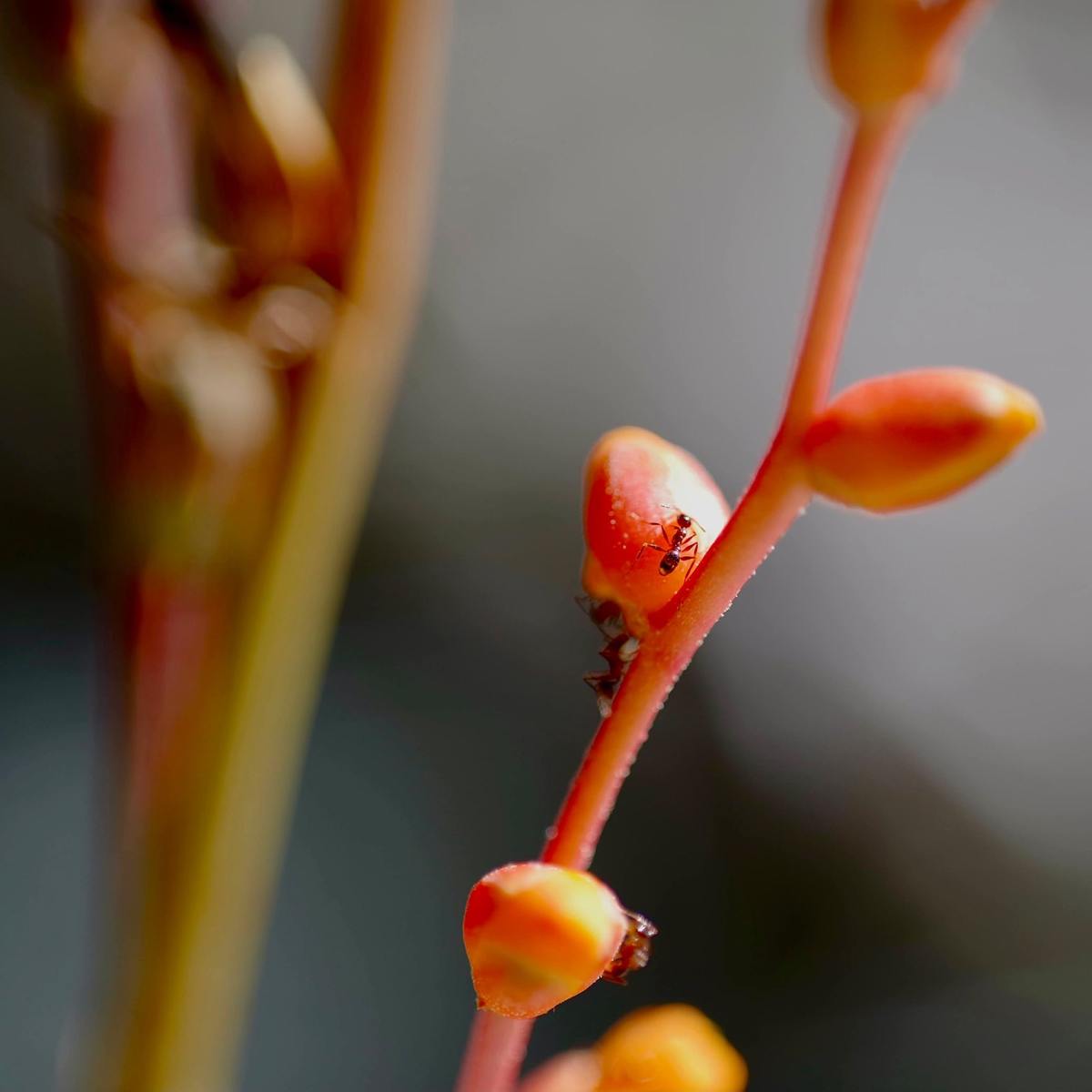
Whether pollination bears fruit depends not only on the pairing but on self-compatibility, which experiments show to differ greatly between species (some set seed with their own pollen, some do not). Our own records point the same way: in sp. ‘Robson’ green form, observation at flowering found no fruit set at all from its own pollen, while pollen from other plants all appeared to set (January 2024); and in May 2026 we recorded another plant as setting nothing by selfing but 100% with other pollen. Our 2024 crossing notes also record more fruit set than expected, in a year when pollinations were deliberately kept limited. The practical side — crossing and sowing — is covered in the “Crossing & Sowing” section of “Growing Dyckia”.
How the Records Are KeptHOW THE RECORDS ARE KEPT
Our flowering records are an extension of the daily growth record. Each plant carries a record tag (#tgn_dyc_…), and the day a bud appears, and the day flowering starts, go into that day's post. Flower photographs sit in the FLOWERS section of each cultivar page, dated as they were taken, in the form “(our plant, YYYY-MM-DD)”. The calendar in this note is that accumulation, counted back up.
Following a plant from bud to bloom has a practical use: in crossing, everything depends on whether the chosen parents flower at the same time. Nor does crossing always begin in spring: in January 2023 the flowering plants were brought indoors and the winter crossing began, and in 2026 the “winter crossing” likewise began from late January into February (later than usual, the record notes). The more flowering records accumulate, the more accurate next year's crossing plan becomes — which plant to bring on first, and how pollen should be stored. How the crossed year and the parent combination are written down is covered in “Names & Cross Formulas”.
SourcesSOURCES
Our own records (posts on both accounts, @togenot.kochi and @barracude — Instagram feeds and Threads, 2023–2026 — the base data for the flowering calendar). World Flora Online (the generic description after Smith & Downs — inflorescence and flower structure). A study of flower morphology (Acta Botanica Brasilica, 2017 — flowers and stigmas of three Dyckia species). Rogalski et al. (reproductive biology of Dyckia brevifolia — flowers per inflorescence, opening sequence, nectar, visitors). Paggi et al. (2019, reproductive biology and pollination of Dyckia excelsa, Plant Species Biology). A study of Dyckia scrutor (Journal of Plant Research — day and night visitors). A study of Dyckia erectiflora (2025 — flowering phenology and bee pollination). Torres et al. (2024 — extrafloral nectaries and ants in Dyckia floribunda and Dyckia longipetala, Plants). San Gabriel Valley Cactus & Succulent Society newsletter, “Dyckia” (inflorescence form; years from seed to flower). San Marcos Growers (the Dyckia marnier-lapostollei page — summer flowering and nectar).
Researched: October 2026