
CULTIVAR
Dyckia dawsonii Bill Baker’s Clone
DataDATA
| Category | Cultivar |
|---|---|
| Record tag | #tgn_dyc_dsn_bbc #tgn_dyc_dsn_bbc_02 |
ProfilePROFILE
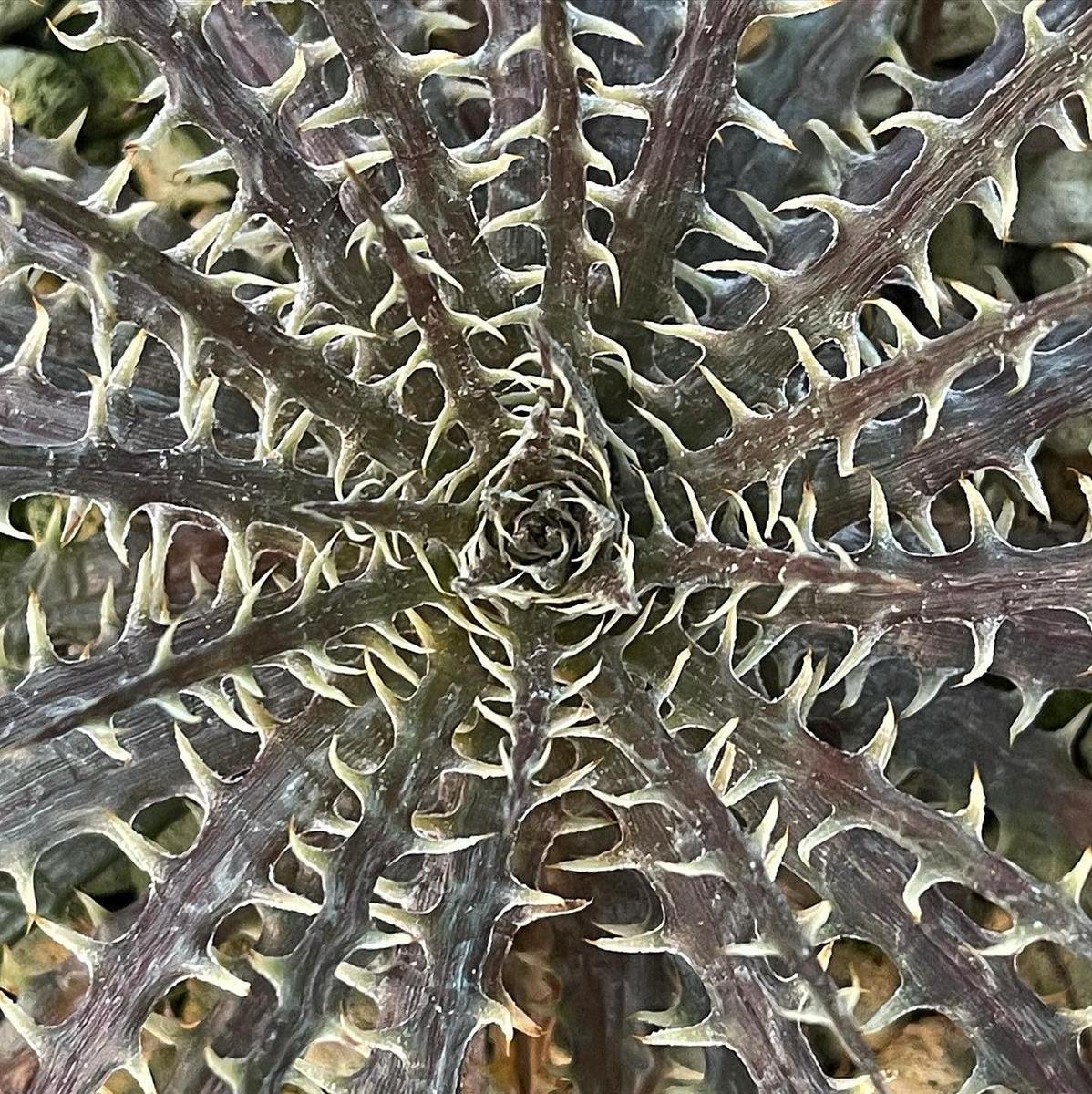
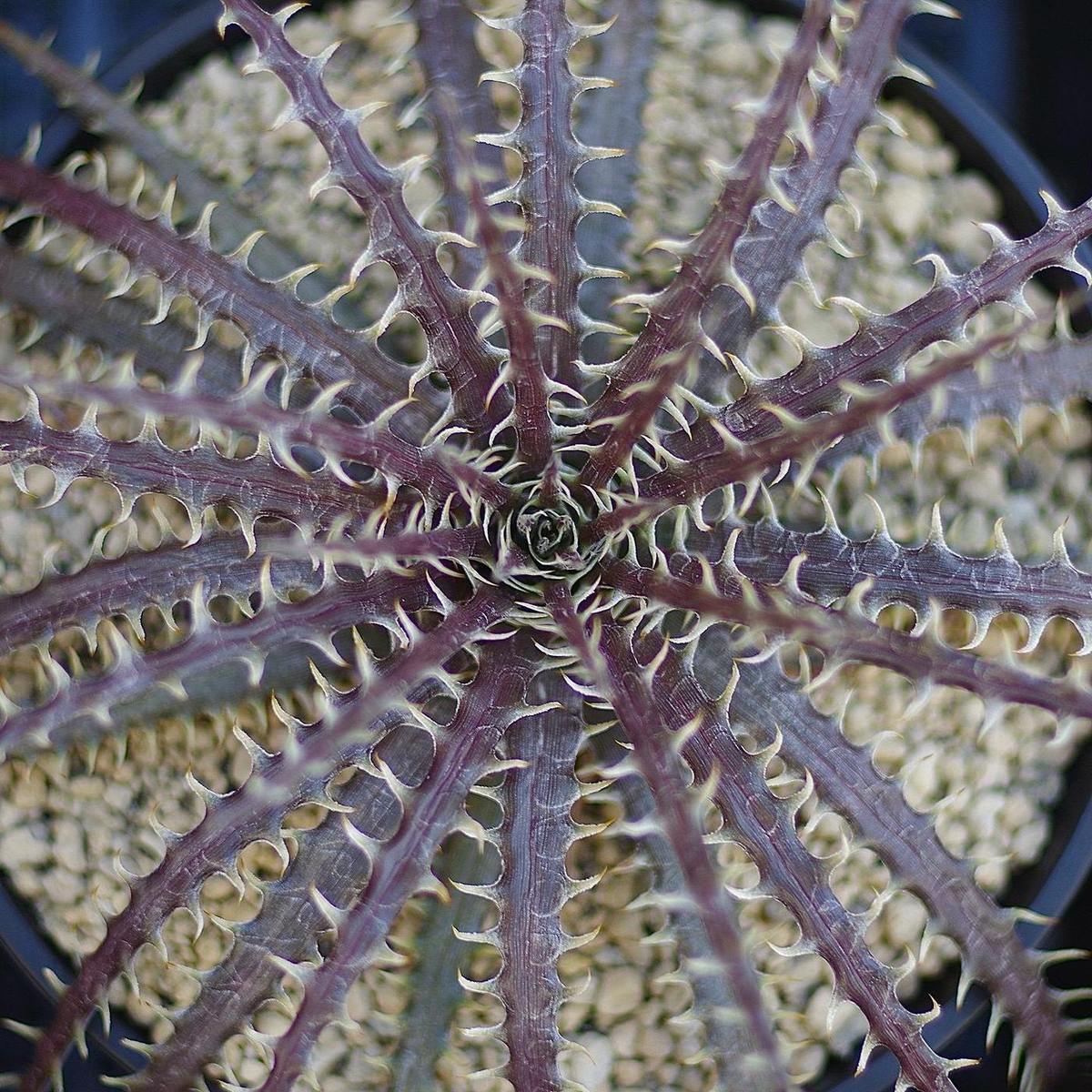
Many long, narrow leaves open densely in a radial rosette, the centre furled small. The leaf ground is a deep dark colour tinged with purple, with few trichomes, so the ground colour dominates. The marginal teeth are pale and large, recurving like hooks and overlapping densely even between the leaves. Recorded as Bill Baker’s Clone of dawsonii, its character rests on the contrast between the dark leaves and the dense teeth. It is not the species itself, but a plant handed down as a clone (a cultivar).
In the records of growers in Japan, this clone is abbreviated BBC and has been used as a parent in a cross with ‘Donna Marie’. Another line of the same species, derived from the Dutch Vandervort collection and brought into Japan via Bryan Chan, is also grown here.
Here we set the species as the literature describes it beside our clone. Dyckia dawsonii lives on rock in the campo rupestre (rocky grassland) of the Cerrado in Goiás, Brazil. In the 1957 protologue, Smith recorded linear leaves only about 7 mm wide at the base, spines 5–7 mm long — nearly as long as the blade is wide — ashy scales over both leaf surfaces, and yellow petals about 9 mm long, and he placed the species near Dyckia niederleinii on floral characters. Flora do Brasil 2020 likewise lists the species only from Goiás.
Set trait by trait against our records for the clone (Bill Baker’s Clone), the description reads as follows.
| Trait | dawsonii as a species (description & literature) | Our clone (our records) |
|---|---|---|
| Leaf width & form | Linear, about 7 mm wide at the base (protologue) | Many long, narrow leaves open densely in a radial rosette; the records call it “slim”. No measured leaf width is on record |
| Leaf colour & scales (trichomes) | Both surfaces covered with ashy scales (protologue) | The leaf ground is a deep dark colour tinged with purple, and the second line (bbc2) colours a vivid red-purple. Trichomes are sparse, so the ground colour dominates |
| Spines — length & form | 5–7 mm long, slender and curved, set laxly — nearly as long as the blade is wide (protologue) | Pale and large, recurving like hooks and overlapping densely. No measured length is on record |
| Flower | Yellow, petals about 9 mm; floral affinity to Dyckia niederleinii (protologue) | No record — we have not yet recorded this clone in flower |
| Growth & size | The protologue gives no indication of size | Recorded as slow-growing (June 2023). No measured size is on record |
| Cold | The protologue makes no mention of cold tolerance | Recorded as giving the impression of standing up well to cold (January 2023) |
Side by side, the points Smith singled out — the narrow leaves, and spines nearly as long as the blade is wide — are there in our clone. Two points sit differently: the spines the protologue calls laxly set look densely overlapping on our plant, and the ashy scales that should cover both surfaces are sparse on ours, the dark ground colour showing through. Whether that is down to growing conditions or is the character of this line is something further records will tell. This comparison matches appearances only; the differing view of what this clone is stands as set out in the Notes.
The GBIF specimens and the wild iNaturalist observations all sit in Goiás (see “Species Distributions”).
NotesNOTES
Dyckia dawsonii Bill Baker’s Clone is a named cultivar. We record it in 8 Instagram posts, from 2023-01-25 to 2026-07-20. Record tag(s): #tgn_dyc_dsn_bbc, #tgn_dyc_dsn_bbc_02.
The species Dyckia dawsonii is a rock-dwelling (rupicolous) plant endemic to the state of Goiás, Brazil. Lyman B. Smith described it in 1957, in the report of the Machris Brazilian Expedition. The type is the plant E. Yale Dawson collected on 10 June 1956 (Dawson 15236), on a rock outcrop along a cerrado canyon about 20 km east of Formoso, in the southern Serra Dourada. Flora do Brasil 2020 likewise lists the species only from Goiás, growing in campo rupestre (rocky grassland) within the Cerrado.
In the original description, Smith placed the species next to Dyckia niederleinii on floral characters, but wrote that “its leaves alone distinguish Dyckia dawsonii from all other species in the genus.” The leaves are linear, only about 7 mm wide at the base, their margins laxly set with slender, curved spines 5–7 mm long — spines nearly as long as the blade is wide. Both leaf surfaces are covered with ashy scales; the flowers are yellow, the petals about 9 mm long. Smith also noted the leaves’ striking similarity to those of Encholirium bradeanum.
A plant from the type collection was already in cultivation in Santa Monica, California, in 1956, and appears as a figure in the original description. In the late 1950s an attractive dawsonii was growing at the Huntington Gardens, and offsets of it are said to have been kept in California by Bill Baker and Dutch Vandervort (research by Derek Butcher; see “The American Roots of Dyckia”). The plant on this page is recorded as the clone of Baker’s line.
There is a dissenting view of what this clone is. The Brazilian grower Constantino Gastaldi, writing on his blog Dyckia Brazil (May 2020), argues that dawsonii itself may be a natural hybrid: the species stayed out of sight in nature for decades, its locality was kept obscure, and when it was refound in recent years it proved strikingly variable in appearance. He illustrates the plant he holds from Baker’s line as “one of its best looking forms,” and in a companion post titles that plant “most probably a hybrid.” Against this, POWO and Flora do Brasil 2020 both accept dawsonii as a species in its own right, and the natural-hybrid idea remains Gastaldi’s personal view. The plant on this page is recorded as Baker’s line, descended through offsets of the Huntington plant — a different history from seed-grown stock, where admixture is a real concern (Butcher likewise cautions about seed collected at the Huntington, where many dyckias grew together).
Our source for this clone, DIFOLA (Dit Formadea), handles it in “types” — one for each parent plant selected by US collectors, tagged with year-and-origin codes. The selection whose leaves colour red-purple is the ‘S-Red-Purple type’ (2011 US): its offsets are offered to special order with a breeding certificate, and seed generations raised at the lab also circulate. The ‘Super Red Type’, known for the strength of its red colouring, centres on a mother plant that reached the lab in 2020. The ‘yellow spine type’, named for its spine colour, is a seed group the lab has bred from a selected parent (code YR2012C), now at its second generation, germinated in 2023. DIFOLA notes that the types become clearly distinct as the plants grow, but that one- to two-year-old seedlings are hard to tell apart. Which type our two recorded lines (#tgn_dyc_dsn_bbc and #tgn_dyc_dsn_bbc_02) belong to cannot yet be determined from our records.
RecordsRECORDS
- 2023-01-25Unbothered by the cold.Instagram
- 2023-04-27Regular check-in — the slim one.Instagram
- 2023-06-19First post in a while — slow-growing but dependable.Instagram
- 2023-08-30The leading plant, wet version.Instagram
- 2023-12-28Growth recordInstagram
- 2025-10-14Growth recordInstagram
- 2026-01-06Growth recordInstagram
- 2026-07-20Growth recordInstagram